2026 Yoga Journal
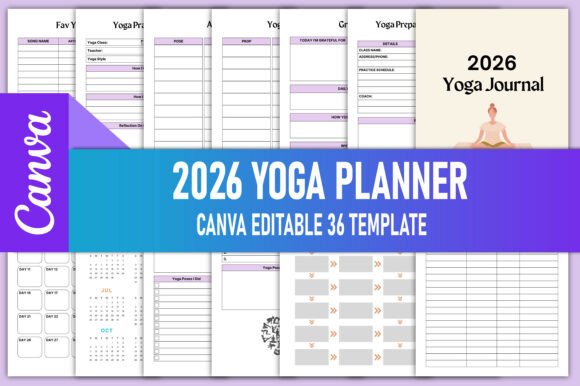
The 2026 Yoga Journal is more than a dated planner—it’s a purpose-built operational tool for practitioners, teachers, creators, and wellness professionals who treat consistency, reflection, and intentionality as strategic advantages. Unlike generic journals, this interior is engineered around the rhythms of sustained practice: not just tracking poses, but mapping growth across dimensions—physical, mental, emotional, and creative. Its 36-page structure (8.5 × 11 inches, KDP-tested, CMYK, 300 PPI) balances depth with usability, avoiding overwhelm while supporting meaningful engagement over time.
Why Timing Matters: The Strategic Value of a Pre-Built 2026 Yoga Journal
Launching a new year with intention isn’t about resolution-setting—it’s about reducing decision fatigue before it begins. A ready-made 2026 Yoga Journal gives you a calibrated framework *before* January arrives: no blank pages to stare at, no formatting delays, no uncertainty about what to record or when. For entrepreneurs building yoga-related courses, educators designing semester-long wellness modules, or freelancers managing multiple self-care commitments, that head start translates directly into execution speed and fidelity to goals.
Consider how this plays out in practice: A studio owner uses the Monthly Planner section to align class themes with seasonal energy shifts—linking winter sequencing to restorative practices and spring planning to dynamic flows. A content creator cross-references the Yoga Challenge Tracker and Meditation Tracker to identify patterns in audience engagement around specific themes (e.g., “30-day breathwork challenges” consistently drive higher newsletter sign-ups). These aren’t incidental insights—they emerge because the journal scaffolds observation, not just logging.
Design That Supports Decision-Making, Not Decoration
This 2026 Yoga Journal avoids decorative clutter. Every section serves a functional outcome:
- My Yoga Journey Pose Journal encourages annotation—not just “Downward Dog,” but notes on hip alignment shifts over six weeks, linking physical feedback to teaching cues;
- Yoga Sequence Builder supports intentional programming, helping instructors prototype classes before demoing them live;
- Yoga Preparation Checklist reduces pre-class cognitive load—especially valuable for hybrid teachers juggling virtual setups, props, and timing;
- 10 Gratitude + Affirmation Pages are spaced deliberately—not daily, but biweekly—to prevent habituation and preserve psychological impact;
- Yoga Glossary + Asanas Reference functions as an in-the-moment knowledge anchor during self-study or peer-led workshops.
That specificity matters. Generic journals often collapse context—blending meditation logs with grocery lists or client notes. This 2026 Yoga Journal maintains domain integrity. When your attention is segmented by design, your recall improves, your patterns become visible, and your adjustments gain precision.
Editable Canva Access: Customization With Purpose
You receive an editable Canva link—not just static PDFs. That means you can adapt the 2026 Yoga Journal to your real-world workflow, not the other way around. But customization only adds value when guided by intent. Before editing, ask:
- What outcomes am I optimizing for? (e.g., client onboarding? teacher training documentation? personal injury rehab tracking?)
- Which sections create friction versus flow? (e.g., if you teach prenatal yoga, swap “Fav Yoga Music” for “Contraindicated Poses & Modifications”)
- Where does standardization serve credibility? (e.g., keeping KDP-tested margins and CMYK color ensures print quality—don’t alter bleed or PPI)
Remember: the Canva file is yours to duplicate and iterate—but only after making a copy in your own account. That preserves the original link’s functionality while giving you full ownership of edits. It also prevents accidental overwrites when updating templates across product lines.
Realistic Use Cases Across Roles
For yoga teachers: Use the Weekly Planner alongside your studio schedule to map teaching hours, prep time, and personal practice windows—then review monthly to spot burnout signals before they escalate. Pair the Yoga Props page with inventory logs to anticipate replacement cycles (e.g., worn-out blocks, fraying straps).
For content creators: Treat the Notes and Bucket List sections as idea incubators. Jot down voice memo snippets from student questions (“Why does my shoulder pop in Chaturanga?”), then revisit during content planning to identify gaps in your library—or opportunities for a short-form explainer series.
For small business owners: Leverage the Thank You page not just for gratitude, but as a lightweight CRM touchpoint log—recording which students referred others, what feedback led to service upgrades, or which workshop themes sparked repeat bookings.
Risks of Using the 2026 Yoga Journal Without Strategy
An unexamined journal becomes ritual without return. Common pitfalls include:
- Tracking without reviewing: Filling pages weekly but never scanning trends across months—missing insights like “I practice most consistently when I sequence the night before” or “My meditation duration drops 40% during travel weeks.”
- Over-customizing early: Adding too many sections before establishing baseline usage leads to fragmented attention and abandoned pages.
- Misaligning format with role: A studio owner using only the Daily Planner while ignoring the Yoga Log misses data that could inform pricing tiers (e.g., peak attendance correlates strongly with specific sequence types).
These aren’t failures of the 2026 Yoga Journal—they’re misalignments between tool and intention. The journal surfaces patterns; it doesn’t interpret them. That requires your judgment, your context, and your willingness to pause and reflect—not just record.
Long-Term Positioning: Beyond 2026
A well-used 2026 Yoga Journal becomes a longitudinal artifact—not just for personal insight, but for professional positioning. After twelve months, those 36 pages hold evidence of evolution: shifts in language (“I used to write ‘I can’t do headstand’—now I note ‘balance improved on Day 22’”), changes in priorities (more space devoted to breathwork vs. asana), or even business pivots (a shift from solo teaching to co-hosted retreats tracked in the Bucket List and Notes sections).
That documented journey builds credibility. When launching a 2027 edition—or a companion course, ebook, or community—you’ll have grounded examples, not abstractions. You’ll know which journal sections resonated most (e.g., practitioners consistently highlighted the Yoga Preparation Checklist as their top time-saver), informing future iterations with confidence.
Practical Next Steps
If you’re evaluating whether this 2026 Yoga Journal fits your needs, begin here:
- Scan the table of contents—not for completeness, but for resonance. Which sections would you open first? Which feel irrelevant *right now*?
- Identify one high-leverage use case (e.g., “Track consistency during my 90-day back-care routine”) and commit to using only those 3–4 related pages for the first month.
- Schedule a 15-minute monthly review—not to judge progress, but to ask: “What surprised me? What repeated? What should I carry forward—or drop—in 2027?”
You’ll receive high-quality print-ready PDFs, PNGs, and JPGs—fully compatible with Amazon KDP. No redesign needed. No guesswork about margins or color profiles. Just clarity, consistency, and control—starting January 1, 2026.
Follow the creator’s profile for updates—not just new journals, but refinements informed by real-world use. Because the most effective tools don’t stay static. They evolve with the people who rely on them.