2026 Grief Workbook Journal
Grieving is not linear—and neither should your support tools be. The 2026 Grief Workbook Journal is designed for real life: quiet mornings, overwhelming afternoons, and everything in between. It’s not a prescriptive manual or a one-size-fits-all checklist. Instead, it’s a thoughtfully structured, deeply compassionate interior template built for people who need space to feel, reflect, and gently move forward—on their own terms.
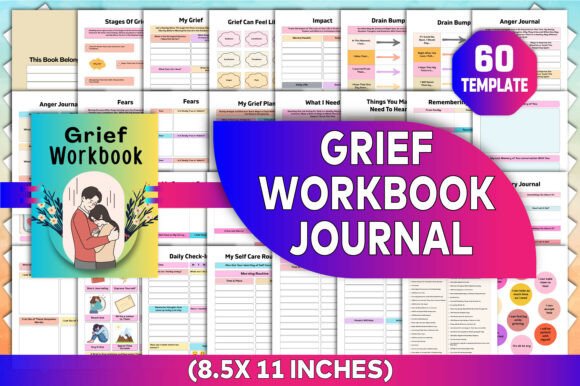
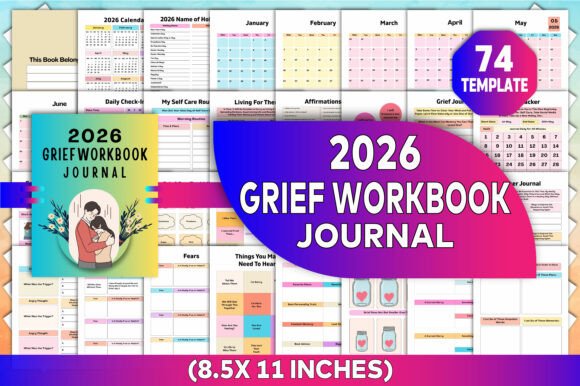
This isn’t just another printable journal. It’s a 74-page, fully editable Canva-based KDP interior—professionally formatted at 8.5 x 11 inches—with intentional design choices that honor complexity: dual-page spreads for layered emotions (like “Anger Journal” and “Fears”), flexible prompts (“What I Need,” “Letting Go,” “Living For Them”), and practical tools (“Habit Tracker,” “Daily Check-In,” “My Support System”) that meet grief where it lives—in routine, memory, and quiet resilience.
Common Missteps—and Why They Matter
Many people download a grief journal expecting immediate clarity—or worse, a “cure.” That sets up unnecessary frustration. Others assume all printable journals are equal, overlooking critical differences in structure, emotional intelligence behind the prompts, or technical flexibility. These assumptions lead to three avoidable pitfalls:
- Choosing based on aesthetics alone. A beautiful cover or pastel color scheme won’t help if the interior lacks psychological grounding. Pages like “Stages Of Grief” and “Growing Around Grief” aren’t decorative—they’re evidence-informed anchors. Without them, users often feel lost in repetition or vague reflection.
- Assuming “editable” means “infinitely adaptable.” Some templates claim customization but lock fonts, spacing, or layout—making personalization superficial. With the 2026 Grief Workbook Journal, every element—from headers to checkboxes—is truly editable in Canva. You can adjust tone, add cultural references, simplify language for teens or elders, or translate sections for bilingual use. That level of control matters when grief intersects with identity, faith, trauma history, or neurodiversity.
- Overlooking format readiness for print or digital use. A PDF that looks sharp on screen may blur or shift margins when printed. This journal delivers print-ready PDFs *plus* high-res JPG and PNG files—so whether you’re self-publishing on KDP, printing locally, or sharing digitally with clients or students, quality stays consistent.
What to Verify Before You Download or Use It
Before opening that Canva link or hitting “print,” ask yourself these questions—not as hurdles, but as thoughtful filters:
- Is the calendar integrated meaningfully? The 2026 Grief Workbook Journal includes a full 2026 monthly planner (Jan–Dec), but more importantly, each month links to reflection prompts like “What felt heavier this month?” or “Where did I notice small shifts?” That connection between time and emotion helps track subtle progress—something generic calendars miss entirely.
- Are pages designed for repeated use—or one-time completion? Notice how “Worry Journal” and “Reflections” appear twice, and “Goodbye Letter” has two unique versions. That’s intentional: grief revisits, rephrases, and reshapes itself. Having space to return—not just once, but with nuance—is part of what makes this resource sustainable over months or years.
- Does it support both private processing *and* shared care? Sections like “My Support System,” “Things You May Need To Hear,” and “Thank You” aren’t afterthoughts. They recognize that grief lives in relationships—not just inside us. If your current journal skips this dimension, it may unintentionally reinforce isolation.
Better Approaches—Practical and Human-Centered
Start small—not with the whole 74 pages, but with one anchor: maybe “Daily Check-In” for grounding, or “Memory Bank” for honoring presence without pressure. There’s no rule that says you must begin on January 1st. In fact, many find deeper resonance beginning on a meaningful date—a birthday, anniversary, or even a quiet Tuesday when energy allows.
If you're a therapist, educator, or coach using this with others: customize the “Affirmations” or “Self Care While Grieving” pages to reflect your practice’s voice or your client’s values. Swap clinical language for warmth, add inclusive pronouns, or embed culturally resonant metaphors (“grief as tide,” “as seasons,” “as roots”). Because healing doesn’t happen in neutral tones—it happens in voices that feel like home.
For creators publishing on KDP: the interior is pre-formatted for Amazon’s specs—including bleed-safe margins and CMYK-ready colors—so you avoid common rejection triggers. And because it’s delivered as an original, 100% customizable file (not a flattened PDF), you retain full rights to brand, expand, or repurpose it—whether as a standalone workbook, part of a grief support bundle, or integrated into a course curriculum.
Realistic Expectations, Real Support
This journal won’t erase pain. But it does something quieter and more lasting: it holds space—without judgment, without rush, without glossing over the messy middle. When someone writes “Grief Can Feel Like…” and fills in “a sweater I can’t take off,” or circles “Drain Bump” after a particularly heavy day, they’re not fixing anything. They’re witnessing. And that act—of naming, recording, returning—is where integration begins.
The “Habit Tracker” isn’t about productivity—it’s about noticing what still feels possible. “Growing Around Grief” isn’t about moving on—it’s about making room for joy *alongside* sorrow. Even the “Notes” page at the end isn’t filler; it’s permission to write what doesn’t fit anywhere else—because grief defies categories.
So if you’ve tried other journals and felt talked down to, overwhelmed by jargon, or disconnected from the content—this is different. It’s built on the understanding that grief isn’t a problem to solve. It’s a human experience to accompany—with honesty, flexibility, and deep respect for where you are right now.
Whether you're navigating loss for the first time, supporting someone else, or creating resources for others—the 2026 Grief Workbook Journal meets you with practical care, not platitudes. And because it arrives as an editable Canva link plus print-ready files, you’re never locked in. You’re empowered—to adapt, to evolve, and to honor grief exactly as it shows up.