Grief Workbook Journal: A Thoughtful, Customizable Companion for Healing
Loss reshapes us—sometimes quietly, sometimes all at once. Whether you’re navigating the sudden absence of a loved one, the slow unraveling of a relationship, or the cumulative weight of multiple losses, grief doesn’t follow a script. It arrives in waves, contradictions, and silences. That’s where the Grief Workbook Journal steps in—not as a fix, but as a grounded, compassionate companion designed to hold space for what’s real.
More Than Pages—A Living Tool for Emotional Navigation
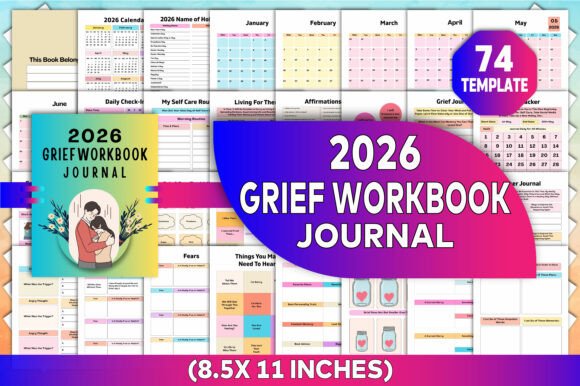
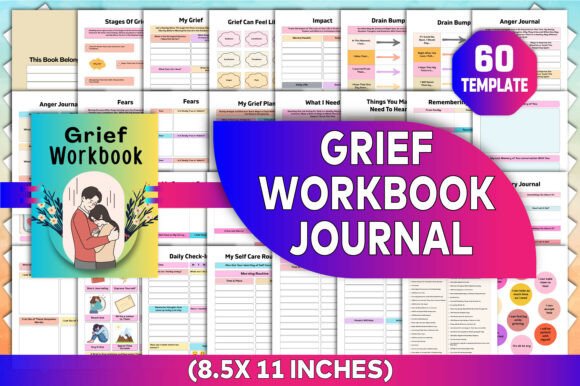
The Grief Workbook Journal isn’t a prescriptive manual. It’s a responsive, deeply human resource built on psychological insight and lived experience. Each of its 60 thoughtfully crafted templates invites reflection without pressure, structure without rigidity. From “Stages of Grief” to “Growing Around Grief,” the journal acknowledges that healing isn’t linear—it’s layered, personal, and often nonlinear.
What sets this apart is intentionality in design. Take the “Drain Bump” and “Anger Journal” pages—two unique layouts each—that honor how grief can manifest as exhaustion or heat, not just sadness. Or “My Grief Plan” and “What I Need,” which gently guide users toward agency amid overwhelm. These aren’t filler pages; they’re functional anchors—designed to help people name feelings they didn’t know had names, reclaim small choices, and begin rebuilding internal stability.
Designed for Real Life—Not Just Theory
Professionals—grief counselors, social workers, hospice chaplains—use the Grief Workbook Journal as a flexible clinical tool. Its clean, accessible layout supports clients who struggle with traditional talk therapy or need tangible ways to process between sessions. One therapist shared how a teen client used the “Goodbye Letter (2 Unique Page)” spread to express unspoken words—then revisited it months later during a “Reflections” entry, revealing subtle shifts in meaning and memory.
For individuals grieving alone, the journal serves as both witness and guide. The “Memory Bank” and “Remembering You” spreads create safe containers for stories and sensory details—the smell of a favorite sweater, the sound of laughter in a certain room. Meanwhile, “Worry Journal (2 Unique Page)” and “Letting Go” offer gentle scaffolding for releasing guilt, uncertainty, or the exhausting habit of rehearsing “what ifs.”
Even caregivers and support partners benefit. The “My Support System” and “Things You May Need To Hear” pages help them articulate needs and boundaries—often overlooked when energy is poured outward. And “Self Care While Grieving” paired with “My Self Care Routine” moves beyond cliché to practical, adaptable actions—even on days when “self-care” feels like remembering to drink water.
Why Editable Canva Interiors Make All the Difference
This isn’t just another printable PDF. The Grief Workbook Journal Canva KDP Interiors deliver professional-grade flexibility. When you download, you receive:
- A fully editable Canva link—no design software required
- Original, 100% customizable files (PDF, JPG, PNG)
- Print-ready 8.5 x 11 inch format at 300 DPI
- 60 interior templates—including 17 distinct journal spreads, 3 Habit Tracker variations, and 2-page features like “Goodbye Letter” and “Fears”
That customization matters. A counselor might add their logo and practice name to the “This Book Belongs To” cover page. An author building a grief-focused course could embed prompts aligned with their curriculum into the “Daily Check-In” or “What Now” sections. A wellness coach might rebrand the “Affirmations” spread with client-specific language. Because everything is editable, the Grief Workbook Journal adapts—not the other way around.
Practical Strengths—and Honest Considerations
Strengths:
- Psychologically grounded: Concepts like “Growing Around Grief” (based on Dr. Lois Tonkin’s model) and “Stages of Grief” (presented as fluid, overlapping experiences—not rigid steps) reflect current understanding in bereavement care.
- Accessible design: Ample white space, clear typography, and intuitive flow reduce cognitive load—critical when focus is fragile.
- Multi-use versatility: Works equally well for personal healing, clinical support, group facilitation, or digital product creation (KDP, Etsy, coaching programs).
- Production-ready: High-res files mean no last-minute formatting stress—whether printing at home, using a local print shop, or uploading directly to Amazon KDP.
Considerations to Keep in Mind:
- This is a tool—not a replacement for therapy. For complex trauma, prolonged grief disorder, or suicidal ideation, professional mental health support remains essential.
- While highly customizable, the Canva template requires basic familiarity with Canva’s interface. Users new to Canva may spend 15–30 minutes learning drag-and-drop editing—but no coding or advanced design skills are needed.
- The journal intentionally avoids prescriptive advice (“You should feel…” or “You must move on…”). Some users expecting step-by-step recovery plans may need time to adjust to its reflective, invitation-based approach.
Real-World Use Cases You Might Recognize
A school counselor printed 20 copies of the Grief Workbook Journal for students after a community loss. She added her district’s crisis resources to the “My Support System” page and used the “Habit Tracker (3 Unique Page)” to co-create gentle routines with teens—tracking sleep, hydration, and moments of connection rather than productivity.
A widow launching a grief-informed coaching business customized the “Living For Them” and “Affirmations” spreads with language rooted in her own journey. She bundled the edited PDF with voice-note reflections and sold it as a digital workbook—crediting the original Grief Workbook Journal Canva KDP Interiors as her foundational framework.
A hospice volunteer gifted hand-bound versions to families during bereavement follow-ups. Using the “Thank You” file, she included personalized notes on the inside cover—transforming a generic journal into a meaningful, tactile keepsake.
Evaluating Fit: Is This Right for You?
Ask yourself:
- Do you value clarity over complexity when emotions feel overwhelming?
- Do you prefer writing, drawing, or quiet reflection over rigid instruction?
- Are you looking for something usable *now*—not after weeks of setup or learning?
- Do you need flexibility—to adapt tone, branding, content, or format—for clients, students, or your own path?
If yes, the Grief Workbook Journal meets you there. It doesn’t assume expertise. It doesn’t demand stamina. It simply offers presence—in ink, in color, in choice.
A Final Note on Permission
Grief asks for permission—to rest, to rage, to remember, to forget, to change. The Grief Workbook Journal extends that permission repeatedly, across its 60 pages. It doesn’t rush healing. It doesn’t measure progress. It holds space for the full, unedited truth of loss—and for the quiet, persistent return of life, reshaped but still alive.
Whether you’re holding it for yourself, sharing it with others, or building from it professionally, this journal begins with one simple, radical idea: Your grief belongs. Your voice matters. Your pace is enough.