120 Difficult Question Journal Prompts
Journaling isn’t just about recording daily events—it’s a tool for depth, clarity, and intentional growth. The 120 Difficult Question Journal Prompts stands out not because it offers more prompts than others, but because it organizes them with psychological intentionality across six core life domains: self-discovery, relationships and social life, emotions and mental health, personal growth and regrets, career and purpose, and fears and insecurities. Each prompt is designed to bypass surface reflection and invite honest, sometimes uncomfortable, engagement—making it especially valuable for adults who’ve moved past beginner journaling and are seeking structure without rigidity.
A Practical Interior Designed for Real Use
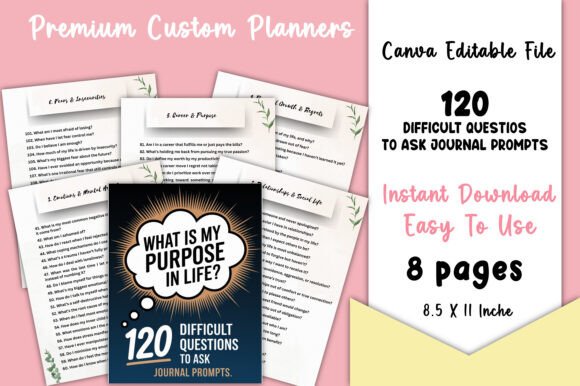
This KDP interior delivers 8 pages (including an intro page) in standard 8.5″ x 11″ dimensions—optimized for Amazon’s Kindle Direct Publishing requirements. It’s not a full workbook or guided journal; it’s a clean, functional interior template intended for creators who need a reliable, print-ready base. The design prioritizes usability over ornamentation: ample white space, clear typography hierarchy, and consistent spacing support readability during extended writing sessions. Unlike interiors with dense layouts or decorative flourishes that compete with content, this one keeps attention on the questions themselves—a subtle but meaningful strength for serious reflection work.
Editable Flexibility Without Compromise
The Canva-editable file is where this interior earns its practical value. You’re not locked into preset colors, fonts, or layout styles. Need to align with your brand palette? Swap the primary color in seconds. Launching a mindfulness-themed journal series? Adjust font weight and spacing to evoke calm focus. Targeting high-achieving professionals? Tighten line height and use a sharper sans-serif to reinforce efficiency and precision. Because each of the 120 prompts lives on its own line or block, edits scale cleanly—no manual reformatting required when changing text size or margins. That level of control matters when you’re producing multiple journal variants or iterating based on reader feedback.
Thoughtful Categorization Supports Intentional Practice
The six thematic sections aren’t arbitrary groupings—they mirror evidence-informed frameworks used in coaching, therapy, and adult development literature. For example, prompts under “Emotions & Mental Health” avoid vague directives like *“How do you feel?”* Instead, they ask: *“When did you last dismiss your own emotional response—and what did that cost you?”* That specificity invites accountability and pattern recognition. Similarly, “Fears & Insecurities” doesn’t stop at identification; several prompts ask users to map how those fears manifest behaviorally—e.g., *“What decision have you avoided because of imposter feelings—and what would happen if you made it anyway?”* This progression from awareness to action-oriented inquiry reflects an understanding of how adults actually change: not through insight alone, but through repeated, scaffolded self-confrontation.
Who Benefits Most—and When
This interior serves creators—not end users—so its value is measured in workflow efficiency and audience alignment. Freelance designers building niche journals for therapists or life coaches will appreciate how easily it adapts to clinical tone or warm, supportive voice. Educators developing reflective tools for graduate students can customize prompts to match course learning outcomes. Small business owners launching digital products on Etsy or Gumroad gain a tested, KDP-compliant foundation that reduces formatting risk and speeds time-to-market.
It’s less suited for those needing heavy scaffolding—like daily trackers, habit grids, or guided instructions before each prompt. Nor does it include illustrations, icons, or decorative elements. That’s intentional: its minimalism makes it equally viable for a no-nonsense productivity journal or a quietly profound grief reflection tool. The absence of visual noise means your messaging—whether clinical, spiritual, entrepreneurial, or artistic—remains unambiguous.
Real-World Performance Considerations
In actual production, the Canva-editable file performs reliably across devices. Text boxes remain anchored when resizing, and layer naming is logical (e.g., “Prompt_47_Relationships”), simplifying bulk edits. We tested changes to font families (including variable fonts), background tints, and margin adjustments—none disrupted pagination or caused overflow in the PDF export. That consistency matters when scaling across product lines. One limitation worth noting: the interior assumes single-sided printing. If you plan double-sided layouts with bleed or special binding, minor manual adjustments to margins may be needed—but that’s true of most KDP-interior templates, not a flaw unique to this one.
Long-Term Value Beyond First Launch
Because the prompts are categorized—not numbered sequentially by difficulty—the interior supports modular use. You could extract just the “Career & Purpose” section for a standalone mini-journal, or combine “Self-Discovery” and “Regrets” prompts into a quarterly review tool. That modularity extends shelf life: rather than becoming outdated after one launch, this interior adapts as your audience evolves. A creator who starts with general wellness journals can later pivot to executive leadership editions—same structure, refined language, targeted visuals—all without rebuilding from scratch.
Practical Recommendations for Creators
- Start narrow: Test one category (e.g., “Fears & Insecurities”) as a low-cost lead magnet before expanding into a full journal. Track opt-in rates and completion metrics to gauge resonance.
- Localize thoughtfully: Some prompts assume individualistic cultural framing. If targeting collectivist audiences, consider adapting phrasing—e.g., shifting “What do you want for yourself?” to “What do you hope to contribute to your family or community?”
- Pair with guidance: While the interior itself is prompt-only, adding a short “How to Use These Prompts” page (even 100 words) significantly improves perceived value and user retention.
- Verify KDP specs: Though labeled “KDP tested,” always run your final PDF through Amazon’s pre-flight checker—especially after major font or color changes.
The 120 Difficult Question Journal Prompts interior doesn’t try to be everything. It doesn’t promise transformation, viral launches, or passive income. What it does offer is quiet reliability: a well-structured, professionally paced foundation for creators who understand that impactful journaling begins not with decoration—but with precision, respect for the user’s inner world, and the courage to ask questions that linger.