2026 Shadow Work Journal Prompts: A Thoughtfully Designed Toolkit for Intentional Growth
Shadow work—the practice of exploring unconscious patterns, repressed emotions, and disowned parts of the self—is no longer a niche interest. In 2026, it’s becoming a foundational habit for professionals, creators, educators, and anyone navigating complexity with clarity. The 2026 Shadow Work Journal Prompts responds directly to this shift: not as a prescriptive manual, but as a flexible, grounded, and deeply personal companion designed for real life—not just theory.
Why This Moment Calls for Structured Reflection
Workflows are faster, communication is fragmented, and emotional bandwidth is thinner than ever. Many adults—especially those juggling entrepreneurship, caregiving, creative output, or hybrid roles—are noticing recurring cycles: misaligned decisions, unexplained fatigue, strained relationships, or goals that stall without clear cause. These aren’t failures—they’re signals. And shadow work offers one of the most accessible, non-clinical ways to decode them.
What makes the 2026 Shadow Work Journal Prompts especially relevant now is its alignment with how people actually engage with self-development today: in short, intentional bursts—not marathon sessions. It integrates seamlessly into existing rhythms: morning planning, weekly review blocks, or quiet Sunday reflection. Unlike static journals, it anticipates the practical needs of modern users—like tracking holidays across time zones, aligning intentions with seasonal energy, or revisiting limiting beliefs before major launches.
More Than Prompts: A Fully Customizable KDP Interior Built for Real Use
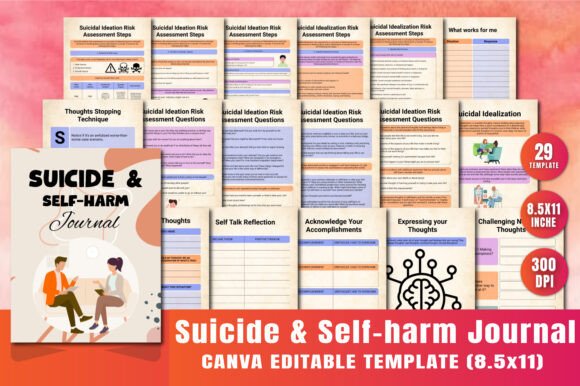
This isn’t just another printable journal. The 2026 Shadow Work Journal Prompts Canva KDP Interiors delivers a high-quality, print-ready interior designed for both professional creators and personal practitioners. Every page serves a purpose—and every element is editable.
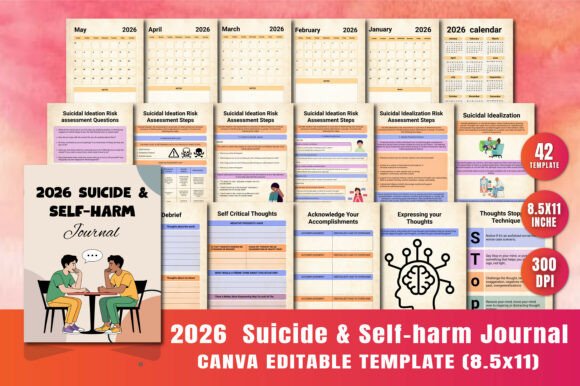
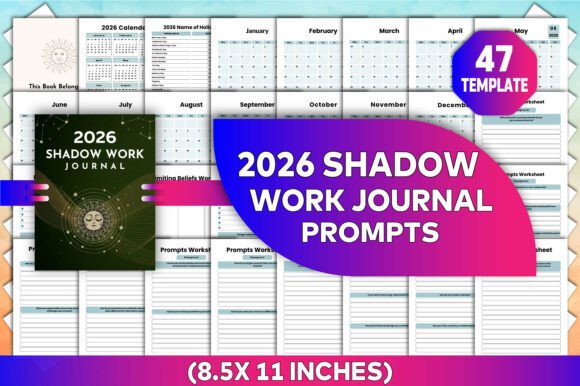
You’ll receive a complete 47-template package—including a full 2026 calendar with named holidays (U.S., U.K., Canada, and Australia observed), monthly planners from January to December, and targeted worksheets like Forgiveness Worksheets, Limiting Beliefs Worksheet, and Healing Worksheet. There’s also space for raw expression (Express And Feel), trauma-informed reflection (My Traumas), symbolic exploration (The Shadow Tarot and The Magician archetype guide), and forward-focused action (Setting Clear Intentions and Problem Solving).
All files are delivered in high-resolution formats: printable PDF (300 DPI), plus JPG and PNG for digital use or design flexibility. The 8.5 x 11 inch size meets standard KDP requirements—making it ideal for authors building their own journal series, coaches offering branded tools, or designers expanding their Canva template library.
Designed for Control—Not Constraint
Every component is 100% customizable. You’re not locked into someone else’s font, color scheme, or layout hierarchy. With the included Editable Canva Link, you can adjust spacing, swap icons, localize holiday names, add your logo, or translate prompts—all without design expertise. That level of control matters: whether you’re tailoring the journal for a specific audience (e.g., neurodivergent users who benefit from visual cues), adapting language for cultural resonance, or aligning tone with your brand voice.
For creators launching on Amazon KDP, this means faster iteration—no need to outsource formatting for each update. For therapists or coaches, it means offering clients a consistent, polished tool they can personalize without compromising therapeutic integrity. For individuals, it means owning the process—not just consuming it.
How It Fits Into Evolving Self-Development Practices
Five years ago, shadow work was often framed through Jungian theory alone—dense, abstract, and intimidating to newcomers. Today, it’s being translated into actionable, scaffolded experiences. Think of the Shadow Self Worksheet or Prompts Worksheet not as replacements for therapy, but as warm-up exercises—ways to build awareness before deeper conversation or integration.
This evolution mirrors broader shifts: rising demand for mental wellness tools that respect autonomy, growing comfort discussing trauma without stigma, and increased attention to how identity, culture, and systemic context shape inner work. The 2026 Shadow Work Journal Prompts reflects that nuance. It includes space for naming societal pressures alongside personal patterns, acknowledges that “healing” isn’t linear, and avoids prescriptive language like “you must forgive” or “release all fear.” Instead, prompts invite curiosity: Where do I feel tension between what I say I value and how I actually spend my time? or What part of me feels safest staying silent—and what would happen if it spoke?
Practical Implications Across Roles
For creators and marketers: This journal interior supports product-led growth. Bundle it with a guided audio series, offer it as a lead magnet with a custom cover, or license the Canva file to course students for hands-on application. Its modular structure lets you highlight different sections per campaign—e.g., spotlight the Forgiveness Worksheets during a relational wellness launch, or feature The Magician archetype guide in a manifestation-themed workshop.
For educators and facilitators: Use individual templates as discussion starters or reflective homework. The Problem Solving and Limiting Beliefs Worksheet pair well with leadership development or conflict resolution training. Because everything is editable, you can add institution-specific guidelines or learning outcomes directly onto the pages.
For freelancers and solopreneurs: Treat this as your operational mirror. Revisit the Setting Clear Intentions page before quarterly planning. Use the Monthly Planner not just for deadlines—but to track emotional capacity alongside task load. Notice which prompts consistently spark resistance—that’s often where growth lives.
For everyday readers: Start small. Pick one prompt per week. Try the Express And Feel sheet after a challenging conversation. Flip to The Shadow Tarot when facing uncertainty—not for prediction, but to explore what archetypal energy might be active beneath the surface. There’s no “right” way to move through it. Consistency matters more than completion.
What Sets This Apart From Generic Planners
Most 2026 planners focus on time management. This one focuses on *meaning* management. It assumes your schedule is full—but asks: What’s filling the space between tasks? It doesn’t just log appointments—it helps you trace the emotional residue of meetings, the hidden cost of people-pleasing, or the quiet grief behind a career pivot.
The inclusion of This Book Belongs To and Thank You Files information may seem minor—but it reinforces ownership and gratitude as structural elements, not afterthoughts. Even the file specifications—300 DPI, layered Canva access, multi-format delivery—reflect an understanding that usability isn’t optional. If a tool feels cumbersome, it won’t be used. This was built to disappear into your routine, not sit on a shelf.
Shadow work isn’t about fixing yourself. It’s about knowing yourself—with honesty, compassion, and precision. The 2026 Shadow Work Journal Prompts gives you the structure to do that work without oversimplifying it. Whether you're designing for others or turning inward for the first time, it meets you where you are—and leaves room for who you’re becoming.