Suicide Self-Harm Journal: A Thoughtfully Designed, Fully Customizable Resource for Mental Health Professionals and Publishers
Creating meaningful, clinically grounded resources for individuals navigating suicidal ideation or self-harming behaviors isn’t just about design—it’s about intention, safety, and accessibility. That’s where the Suicide Self-harm Journal stands apart. Built from the ground up for real-world use, this journal isn’t a generic template repurposed for sensitive topics. It’s a purpose-built, trauma-informed interior layout—thoughtfully structured, ethically aligned, and ready for immediate customization and print deployment.
Why This Suicide Self-harm Journal Meets Modern Clinical and Publishing Needs
In today’s mental health landscape, practitioners, coaches, nonprofit educators, and KDP publishers need tools that balance clinical integrity with practical usability. A Suicide Self-harm Journal must do more than look professional—it must support reflection without triggering, guide users toward safety without oversimplifying risk, and empower agency without assuming readiness. This journal delivers exactly that.
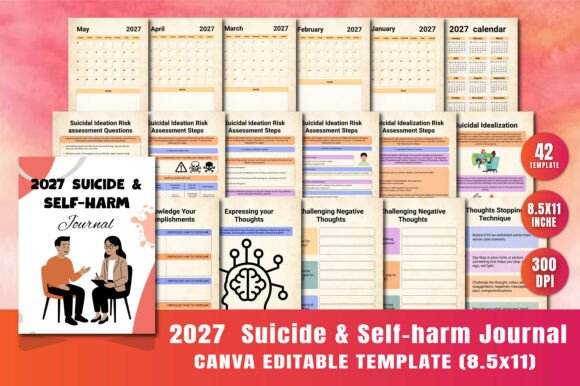
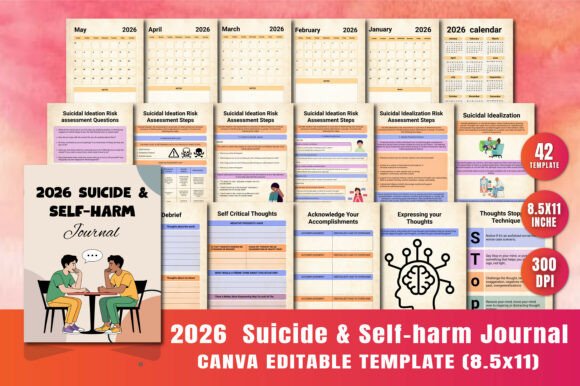
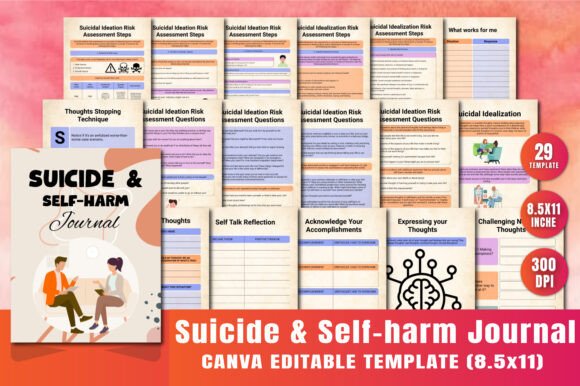
Each of its 29 fully designed interior pages serves a distinct therapeutic function—no filler, no redundancy. From the “This Journal Belongs To” page (a gentle, grounding entry point) to multi-step Crisis Thoughts Reflection prompts, the flow mirrors evidence-informed frameworks like dialectical behavior therapy (DBT) and safety planning interventions. The Risk-Awareness Safety Planning Worksheets aren’t static checklists—they’re dynamic, stepwise guides that help users identify early warning signs, internal coping strategies, social supports, and professional contacts—all in one cohesive sequence.
What Makes the Canva KDP Interior Template So Practical?
You don’t need Adobe InDesign experience—or even intermediate graphic design skills—to adapt this Suicide Self-harm Journal. The editable Canva template is built with simplicity and flexibility in mind. Every element—text boxes, icons, borders, color swatches—is layered and labeled for intuitive editing. Change fonts to match your brand’s voice. Swap muted blues for warm terracottas to evoke calm or resilience. Adjust spacing to improve readability for neurodivergent users. Add your logo to the cover or insert your organization’s crisis hotline on the inside back cover.
And because it’s built for KDP and commercial printing, every file meets strict technical standards: US Letter size (8.5 x 11 inches), 300 DPI resolution, CMYK-ready PDFs, and clean JPG/PNG exports for digital previews or website mockups. No last-minute resizing. No pixelated text. No color shifts between screen and print.
Inside the Structure: Pages That Work With, Not Against, the User
Let’s look at how key sections serve both therapeutic intent and user engagement:
- Guided Assessment & Self-Check Questions (6 pages): These aren’t diagnostic tools—but they *are* compassionate invitations to pause, observe, and name what’s happening internally. Phrased in nonjudgmental language (“When did you first notice this feeling?” vs. “Why did you feel this way?”), they reduce defensiveness and support honest self-reporting.
- Thought-Interrupting Technique Worksheets (4 pages): Grounded in cognitive-behavioral principles, these offer concrete, actionable alternatives to rumination—breath anchors, sensory grounding prompts, and quick redirection exercises. They’re intentionally brief, so users can engage even during low-energy moments.
- Acknowledge Your Accomplishments & Healthy Self-Talk Reflection: Too often, journals focus only on struggle. This one makes space for strength. Celebrating small wins—even “I got out of bed today”—builds self-efficacy over time. Paired with guided rewriting of self-critical statements, it gently reshapes inner dialogue.
- Weekly Reflection + “What Works for Me” Worksheet: Rather than prescribing rigid routines, this section invites users to track patterns and personalize strategies. Did walking after dinner lower anxiety? Did texting a friend interrupt an urge? That insight becomes portable, repeatable, and empowering.
Real-World Use Cases: Who Benefits—and How?
This Suicide Self-harm Journal was created with multiple audiences in mind—not just end users, but the professionals and entrepreneurs who serve them.
Mental health clinicians use it as a low-barrier adjunct to therapy—assigning specific worksheets between sessions, customizing prompts to align with treatment goals, or printing tear-out pages for in-session work. Its structure supports continuity without requiring extra prep time.
KDP publishers appreciate how easily it converts into a polished, market-ready product. With full Canva editability, you can launch multiple versions—a teen-focused edition with illustrated headers, a Spanish-language adaptation, or a faith-integrated version with values-based reflection prompts—all from the same base file.
Nonprofits and university counseling centers integrate it into wellness toolkits, peer support programs, or campus mental health campaigns. Because all files are print-ready and royalty-free for internal use, there’s no licensing friction or per-copy cost.
Customization That Respects Sensitivity and Scope
“100% customizable” doesn’t mean “anything goes.” Thoughtful customization matters here. You can adjust colors to support emotional regulation—cool tones for calming, high-contrast options for visual accessibility—but the underlying framework stays intact. You can translate content or add culturally responsive examples—but the safety-first architecture remains unchanged. That balance is intentional: flexibility without compromising clinical grounding.
For example, swapping out a generic “contact a friend” prompt for “reach out to someone who knows your safety plan” adds specificity and accountability. Adding a QR code that links directly to the 988 Suicide & Crisis Lifeline (or your local equivalent) turns static text into immediate, actionable support.
Time, Cost, and Creative Energy—All Preserved
Designing a journal like this from scratch takes dozens of hours: researching best practices, drafting prompts, iterating layouts, testing readability, exporting print files, troubleshooting bleed and margin issues. This Suicide Self-harm Journal Canva KDP Interior eliminates that overhead—not by cutting corners, but by delivering rigor already baked in.
You’re not buying a placeholder. You’re getting a production-ready foundation: professionally spaced typography, consistent hierarchy, accessible contrast ratios, and logical pagination. What you invest is creativity—not technical labor. That means faster time-to-market, cleaner branding alignment, and more energy to invest in outreach, client care, or community education.
Final Considerations Before You Customize
While this journal is highly adaptable, keep these practical notes in mind:
- Always consult clinical guidelines when adapting content for specific populations—especially minors, veterans, or individuals with complex trauma histories.
- Include disclaimers clearly: This is a supportive tool, not a substitute for professional care. Place crisis resources prominently—not buried in fine print.
- Test readability with real users whenever possible. Font size, line spacing, and white space impact engagement more than most designers anticipate.
- Consider pairing with facilitator guides—even a simple one-page “How to Use This Journal” handout increases uptake and reduces misinterpretation.
At its core, this Suicide Self-harm Journal reflects a deeper truth: compassionate mental health tools shouldn’t be hard to make, hard to access, or hard to trust. They should be clear, capable, and quietly courageous—just like the people who use them.