Empower Your Mental Health Journey: The Bipolar Disorder Therapy Journal & Canva KDP Interior Bundle
Living with bipolar disorder is deeply personal—and profoundly complex. It’s not just about mood swings; it’s about navigating intense emotional shifts, managing energy fluctuations, recognizing early warning signs, and building sustainable coping strategies. In this landscape, consistency matters. Structure helps. And one of the most powerful, evidence-informed tools you can integrate into daily life is journaling—especially when it’s purpose-built, clinically grounded, and fully customizable.
What Is a Bipolar Disorder Therapy Journal—And Why Does It Work?
A Bipolar Disorder Therapy Journal is more than a notebook—it’s a therapeutic companion designed specifically for people living with bipolar I, bipolar II, cyclothymia, or related mood conditions. Unlike generic journals, it includes targeted prompts, structured worksheets, and cognitive-behavioral therapy (CBT)-informed exercises proven to support emotional regulation, self-awareness, and relapse prevention.
Research consistently shows that expressive and reflective writing improves mood stability, reduces symptom severity, and strengthens metacognitive skills—the ability to observe your own thoughts without immediate reaction. When paired with clinical frameworks like thought records, behavioral activation logs, and crisis planning, journaling becomes an active part of treatment—not just documentation.
Why This Journal Stands Out: 100% Customizable + Print-Ready + Clinically Thoughtful
This isn’t a static PDF you print once and outgrow. You receive a fully editable Canva template, plus high-resolution printable files (PDF, JPG, PNG), all sized at 8.5 x 11 inches, 300 DPI, no bleed—ready for professional printing or home use. Every page is 100% customizable: change fonts, colors, headers, layout—even add your logo or branding if you're a therapist, coach, or wellness entrepreneur.
With 34 thoughtfully curated pages, the journal balances science and soul. It doesn’t assume expertise—just intention. Whether you’re newly diagnosed, supporting a loved one, or guiding clients, this resource meets you where you are.
Inside the Journal: A Closer Look at Key Sections
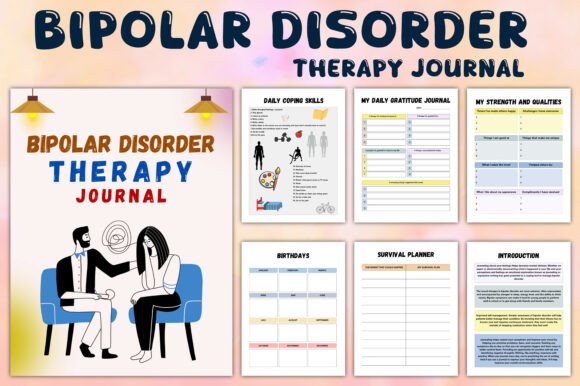
- This Book Belongs To & Table of Contents — Personalize ownership and navigate intuitively.
- List of Emotions & My Thoughts Playlist — Build emotional literacy by naming nuanced feelings and linking them to triggers or patterns.
- My Strengths and Qualities & Positive Talk Journal — Counteract depressive bias by reinforcing identity beyond diagnosis.
- Overcoming Negative Thoughts & Thought Record Chart — Practice cognitive restructuring using CBT’s “evidence for/evidence against” method.
- Rain Anxiety vs. Truth Exercise — A gentle, visual metaphor to separate overwhelming emotion from factual reality.
- My Brain Dump List & Daily Self-Care Notes — Release mental clutter and anchor care in actionable, non-negotiable habits.
- Manic Episode Criteria & My Behavior Journal — Track subtle shifts in sleep, speech, spending, or impulsivity before escalation.
- Daily Coping Skills & Weekly Checklist — Reinforce micro-wins and build routine resilience.
- Crisis Plan & Anger Worksheet — Proactively outline steps, contacts, and grounding techniques for moments of overwhelm.
- Draw Your Thoughts & Notes Pages — Honor neurodiverse expression—sometimes words aren’t enough.
Designed for Real Life—Not Just Theory
We know therapy doesn’t stop at the session door. Nor does healing happen only on a couch. This journal bridges clinical insight with daily reality—whether you’re juggling remote work, parenting, creative projects, or recovery milestones. Its clean, accessible design avoids clinical coldness while maintaining therapeutic rigor.
For example: the Daily Gratitude Journal isn’t about forced positivity. It invites small, sensory-based acknowledgments (“warm tea,” “a text from my sister,” “sunlight through the window”)—a practice shown to gently lift baseline mood over time. Or the Self-Talk Log, which helps identify automatic negative thoughts (“I’ll never get better”) and reframe them with compassion (“I’m learning, and progress isn’t linear”).
Therapists, Coaches & Creators: Why This Is a Business-Saving Resource
If you’re a mental health professional, life coach, educator, or digital creator, this journal does more than support clients—it supports your workflow and impact.
✅ Save hours per week: No more designing worksheets from scratch or stitching together free PDFs with inconsistent formatting.
✅ Scale your offerings: Brand it as your own guided journal, sell it on Etsy or your website, or bundle it with coaching packages.
✅ Ensure clinical alignment: Every prompt reflects best practices—not pop psychology—so you maintain integrity and trust.
✅ Meet diverse needs: Edit layouts for accessibility (larger fonts, dyslexia-friendly type), translate sections, or adapt for teens, seniors, or neurodivergent users.
And because it’s delivered as an editable Canva link, updates take minutes—not days. Launch a seasonal version (“Winter Wellness Edition”), add telehealth prep pages, or create a teen-focused variant—all without hiring a designer.
Dispelling Common Misconceptions
Misconception: “Journaling is just venting on paper.”
Truth: Structured therapeutic journaling is a skill—one that rewires neural pathways over time. This journal guides that process intentionally.
Misconception: “If I’m on medication, I don’t need tools like this.”
Truth: Medication manages biology; journaling builds psychological resilience. They’re complementary—not competing—parts of care.
Misconception: “This is only for people in crisis.”
Truth: Prevention is proactive. Tracking subtle shifts *before* episodes emerge is where real stability begins.
How to Use This Journal—Your Way
There’s no “right” way—but here are flexible, research-backed approaches:
- Start small: Pick one section—like Daily Coping Skills—and commit to 2 minutes each morning.
- Pair with routine: Keep it beside your coffee maker, not buried in a drawer. Consistency > volume.
- Review weekly: Flip back every Sunday. What patterns emerged? Where did support show up? What felt hard—and why?
- Share selectively: Bring your Crisis Plan or Behavior Journal to your next appointment—it transforms conversations from “How have you been?” to “Here’s what the data shows.”
- Customize meaningfully: Add affirmations in your voice, insert favorite quotes, or paste in photos that ground you.
Your Time, Energy, and Clarity Are Worth Protecting
In a world that glorifies hustle and hides struggle, choosing a tool like this journal is quietly revolutionary. It says: I honor my complexity. I invest in understanding myself. I refuse to let bipolar disorder define me—I choose to co-create my wellness, one thoughtful page at a time.
And for professionals? It says: I show up with clarity, care, and efficiency—so my clients feel seen, supported, and empowered—not managed.
Final Thoughts: More Than Paper—It’s Partnership
The Bipolar Disorder Therapy Journal + Canva KDP Interiors Bundle is more than a product. It’s a collaboration between clinical wisdom and creative flexibility. Between science and self-expression. Between structure and sovereignty.
You get high-quality print-ready files, an editable Canva template, and 34 pages of intentional, trauma-informed design—all in one download. No subscriptions. No watermarks. No limitations on customization or use.
Whether you’re turning inward for healing—or outward to serve others—this journal meets you with respect, precision, and quiet strength. Because managing bipolar disorder shouldn’t mean choosing between practicality and compassion. With this resource, you don’t have to.