2026 Suicide Self-Harm Journal
A thoughtful, grounded tool designed for emotional awareness and personal safety—not as a substitute for professional care, but as a compassionate companion in moments of distress. The 2026 Suicide Self-harm Journal is a structured, trauma-informed resource built around reflection, grounding, and self-advocacy. It’s not a clinical intervention—it’s a practical, accessible way to pause, name what’s happening internally, and reconnect with intentionality—even on difficult days.
Why This Matters—Differently—for Different People
For someone navigating recurring suicidal thoughts or self-harming urges, consistency and accessibility matter deeply. A journal that feels safe to open—without judgment, without complexity—can be the difference between spiraling silently and reaching for a small, stabilizing action. That same journal may serve a therapist differently: as a collaborative tool to reinforce skills between sessions, track patterns over time, or gently introduce safety planning in a low-pressure format.
A school counselor might use the 2026 Suicide Self-harm Journal with older teens who respond better to visual structure than abstract talk. An educator supporting students’ mental wellness could adapt its reflection prompts for classroom SEL activities—modifying language, removing sensitive content, or using pages like “What Works for Me” to build resilience literacy.
For creators and small business owners publishing mental health resources, this journal isn’t just another product—it’s a foundation. Its Canva-based interior files let you customize tone, imagery, and language to align with your audience’s values: clinical clarity for healthcare professionals, warm minimalism for wellness coaches, or culturally responsive phrasing for community-based practitioners.
What You Actually Get—and Why It Saves Time Without Sacrificing Care
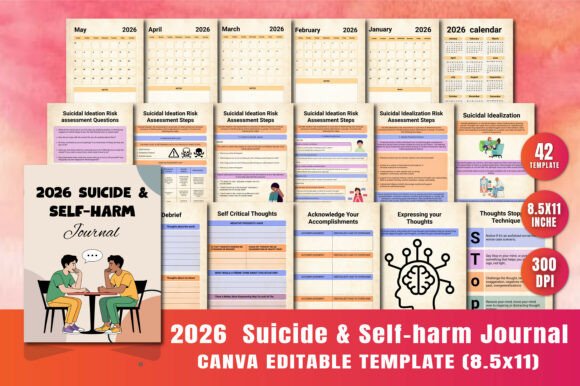
You receive a complete, ready-to-use interior file set: printable PDF, JPG, and PNG formats—all at 300 DPI, US Letter size (8.5 × 11 inches), optimized for crisp printing. Plus, an editable Canva template that opens directly in your browser. No design software needed. No licensing fees. No waiting for a developer.
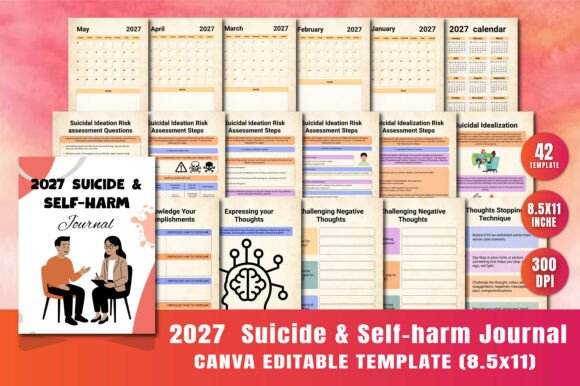
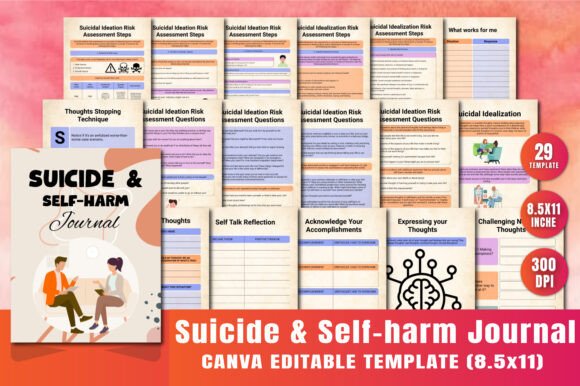
The 42 interior pages include:
- A “This Journal Belongs To” cover page—personalized from day one
- A full 2026 calendar and monthly planner (January–December) with space for gentle tracking—not rigid productivity
- Crisis thoughts reflection pages that guide naming, noticing, and grounding—not analyzing or fixing
- Risk-awareness and safety planning worksheets (5 pages), written with clinical humility and real-world usability
- Guided self-check questions (6 pages) that invite curiosity instead of self-diagnosis
- Thought-interrupting technique worksheets (4 pages) grounded in behavioral activation and sensory awareness
- Healthy self-talk and acceptance reflections—including space to acknowledge small wins, challenge self-criticism, and debrief weekly
- “What Works for Me” pages that help users build personalized coping repertoires over time
- Flexible notes pages and two sincere, unobtrusive “Thank You” pages—because showing up matters
How Skill Level Shapes Use
Beginners often need clarity, not complexity. If you’re new to journaling—or new to managing intense emotions—the 2026 Suicide Self-harm Journal meets you where you are. Prompts are direct but kind. Layouts avoid clutter. There’s no pressure to “fill every line.” You can start with just one page: the “Crisis Thoughts Reflection” or even the blank notes section. The Canva template means you can change fonts, colors, or spacing to reduce visual overwhelm—no design experience required.
Experienced users—whether therapists, peer supporters, or long-term journalers—value flexibility and depth. They’ll appreciate how the interior pages layer support: from immediate grounding (thought-interrupting techniques), to pattern recognition (monthly planner + reflection), to proactive safety building. Because everything is 100% customizable, they can add clinical references, translate sections, integrate local crisis numbers, or adapt language for neurodivergent processing styles.
Creators and publishers see this as infrastructure—not just content. Need a version for Spanish-speaking teens? Swap text in Canva. Want to brand it with your logo and color palette? Done in minutes. Planning a bundle with mindfulness guides or mood trackers? These files integrate cleanly. You keep full commercial rights, so whether you’re selling print-on-demand, offering digital downloads, or distributing through community health programs, you control the message and the margins.
Practical Examples Across Roles
A freelance graphic designer launching a mental wellness print shop uses the Canva template to rebrand the journal with soft blues and hand-drawn accents—then adds QR codes linking to free local crisis resources. She sells both digital and printed versions, keeping overhead low and impact high.
A licensed clinical social worker prints copies for clients who struggle with traditional therapy homework. She highlights only three pages per session—say, the “Safety Planning Worksheet” and “Acknowledge Your Accomplishments”—so it feels manageable, not burdensome.
A university wellness center adapts the “Weekly Reflection” and “What Works for Me” pages into a free downloadable PDF for students. They remove branding, simplify headers, and pair it with a short video walkthrough—making evidence-informed tools feel approachable, not clinical.
A parent supporting a teen in outpatient care uses the journal alongside family therapy. They don’t read it—but they notice when their child chooses to write, and they honor that choice without pressure. The physicality of the printed journal—its weight, its quiet presence on a nightstand—becomes part of the routine.
What This Isn’t—and Why That Matters
This isn’t a replacement for therapy, psychiatric care, or emergency support. It doesn’t diagnose, treat, or promise outcomes. It doesn’t assume everyone has the same capacity, language, or access to safety. Its strength lies in its restraint: clear boundaries, respectful pacing, and room for silence.
It also isn’t locked behind paywalls, subscriptions, or proprietary apps. You own the files. You decide how—and whether—to share them. That autonomy matters, especially for people who’ve experienced systems that override their voice.
Does This Fit Your Needs?
If you value intention over aesthetics—if you prioritize function, flexibility, and human-centered design—this journal aligns. If you need something fast to implement but meaningful to sustain, it delivers. If you’re building resources for others, it gives you creative control without technical debt.
But if you’re looking for automated reminders, AI analysis, or real-time clinician feedback—this isn’t that tool. And if your goal is purely decorative journaling without therapeutic scaffolding, other templates may suit better.
Ask yourself: Do I need structure that honors complexity without demanding perfection? Do I want to spend less time formatting and more time supporting? Can I trust this to hold space—not fix, not judge, but witness?
When those questions resonate, the 2026 Suicide Self-harm Journal isn’t just a download. It’s a quiet act of alignment—with care, with craft, and with the people who show up, again and again, trying to stay.