Unlock Your Inner World with the 2025–2026 Dream Journal Canva
What if your dreams weren’t just fleeting images—but a rich, accessible source of insight, creativity, and self-awareness? The 2025–2026 Dream Journal Canva bridges that gap. Designed for dreamers, journalers, therapists, writers, and curious minds alike, this editable digital planner transforms how you record, reflect on, and learn from your nightly experiences.
More Than Just Pages—A Thoughtfully Built System
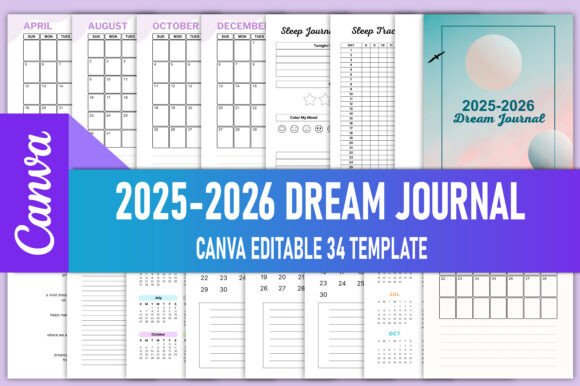
This isn’t a generic notebook with blank lines. It’s a purpose-built toolkit—34 thoughtfully structured templates in one cohesive package. Each page serves a distinct role in deepening your relationship with sleep and subconscious thought.
You’ll find dedicated sections for:
- Sleep tracking—log bedtime, wake time, quality, and interruptions to spot patterns;
- Dream recording—with space for emotions, symbols, people, and sensory details;
- Common dreams decoder—a quick-reference guide for recurring themes like falling, flying, or being unprepared;
- How to remember your dreams—practical tips grounded in neuroscience and habit science;
- Types of dreams—lucid, prophetic, healing, nightmare, false awakening—each explained in plain language;
- Dream journal notes—for reflections, questions, connections to waking life, and intuitive hunches.
All pages align with the 2025–2026 calendar, so monthly planning flows seamlessly into dream work. You’re not juggling two separate tools—you’re building continuity between intention, action, and inner experience.
Why Editable Canva Is a Game-Changer
The 2025–2026 Dream Journal Canva comes with a fully editable Canva link—not just static PDFs. That means you’re not locked into someone else’s layout or tone. Want softer pastel tones? Swap fonts to match your aesthetic? Add your own affirmations or prompts? You can.
Here’s how it works: after purchase, you receive a direct Canva link. Important note: To keep the original link active and avoid accidental edits to the master file, go to your Canva home and click “Make a copy” before customizing. That way, your version stays yours—and updates won’t overwrite your changes.
This flexibility matters because dream journaling isn’t one-size-fits-all. A student may want minimalist pages with room for sketching symbols. A therapist might add client consent checkboxes or clinical reflection prompts. A creative writer could embed character inspiration grids or plot-thread trackers. With editable access, you shape the tool—not the other way around.
KDP-Ready Files—No Design Headaches, Just Upload & Publish
If you're an Amazon KDP creator—or planning to be—the technical specs here are built for success. Every file is KDP-tested: 8.5 × 11 inches, no bleed area, CMYK color mode, and 300 PPI resolution. That means crisp text, accurate colors, and zero formatting surprises when your paperback goes live.
You’ll receive:
- High-quality print-ready PDFs (ideal for KDP interior uploads);
- PNG files (great for cover mockups or social media previews);
- JPG exports (lightweight and versatile for email, blogs, or ads).
No wrestling with margins, no guessing at color profiles, no last-minute panic over bleed settings. Everything is pre-optimized—so you spend time on content, marketing, and reader value—not troubleshooting printer guidelines.
Real-Life Use Cases: Who Benefits Most?
Self-guided explorers love this journal because it balances structure with openness. You don’t need prior dreamwork experience—just curiosity. The “How to Remember Your Dreams” section alone helps reset habits: keeping a notebook by your bed, writing immediately upon waking, using voice memos when typing feels too slow. These small shifts compound quickly.
Creative professionals use it differently. A screenwriter tracks symbolic motifs across months; a visual artist sketches dream scenes in the margin spaces; a poet mines emotional resonance from recurring dream characters. The clean 8.5 × 11 layout gives ample breathing room—no cramped lines stifling inspiration.
Mental wellness practitioners integrate select pages into client handouts or group programs. The “Sleep Tracker” pairs naturally with CBT-I protocols. The “Types of Dream” section supports psychoeducation without jargon. And because it’s editable, clinicians can insert HIPAA-compliant headers or session-specific prompts—no extra design fees required.
Design Details That Make a Difference
Look closer, and you’ll notice thoughtful craftsmanship:
- Subtle, calming interiors—soft gradients, gentle line weights, and intentional white space reduce cognitive load;
- Consistent typography hierarchy—headings stand out, body text remains legible even in low-light morning writing;
- Functional margins—wide enough for binding, narrow enough to maximize usable space;
- Print-safe contrast—tested across multiple KDP proof copies to ensure readability in both matte and glossy finishes.
This isn’t decoration for decoration’s sake. Every choice supports usability—especially during those groggy, half-awake moments when clarity matters most.
How to Get the Most Out of Your 2025–2026 Dream Journal Canva
Start simple. Pick just one template for the first week—maybe the Sleep Tracker + one Dream Record page. Don’t aim for perfection. Aim for consistency.
Keep your journal within arm’s reach of your pillow—not across the room. Even a 90-second entry builds neural pathways that strengthen recall over time.
Review monthly. Flip back through your 2025–2026 Dream Journal Canva entries once a month. Look for emotional trends (“I felt anxious in 70% of my recorded dreams this month”), seasonal shifts (“More water imagery in winter”), or unexpected synchronicities (“That symbol appeared in a dream the night before my job interview”). Patterns emerge slowly—but they’re always there.
And if you ever hit a dry spell? Use the “Common Dreams” section as a prompt starter. Or try the “Dream Recall Tips” again—even seasoned journalers revisit fundamentals.
Why This Stands Out in a Crowded Niche
There are plenty of dream journals online. But few combine editability, KDP readiness, scientific grounding, and aesthetic cohesion in one package. Many offer only PDFs—locking users out of customization. Others prioritize art over function, sacrificing usability for beauty. Some skip practical sleep context entirely.
The 2025–2026 Dream Journal Canva refuses those trade-offs. It assumes you’re serious about growth—but also human. You might want lavender tones today and charcoal gray tomorrow. You might need a version for teens, another for trauma-informed work, or one branded for your coaching business. With full Canva access, you’re never starting from scratch.
Plus, it’s future-proof. Since it covers 2025 *and* 2026, you get two full years of planning—no mid-year re-purchase. That’s real value, especially if you’re building a product line or offering journaling bundles.
Final Thought: Your Dreams Deserve Space—And This Is It
Your subconscious doesn’t speak in bullet points. But it *does* respond to attention, repetition, and care. The 2025–2026 Dream Journal Canva gives your inner world the structure it needs—and the freedom it deserves.
Whether you’re uploading to KDP, gifting to a friend, or beginning your own dreamwork journey—it’s ready when you are. High-resolution. Thoughtfully organized. Fully yours to adapt.
If you appreciate intentional design and practical depth, follow the creator’s profile for new releases—including upcoming themed journals, guided reflection packs, and seasonal planners designed with the same care.