2026 Anxiety Depression Workbook
What if your daily mental wellness practice didn’t mean choosing between clinical rigor and creative expression? The 2026 Anxiety Depression Workbook bridges that gap—not as a static checklist, but as a living, editable system designed for real life. It’s not just another journal. It’s a thoughtfully structured, print-ready PDF toolkit built for emotional awareness, behavioral consistency, and personal agency—backed by evidence-informed frameworks like thought reframing, grounding exercises, mood logging, and self-assessment.
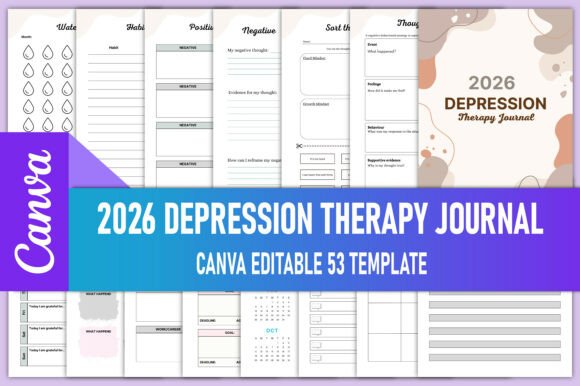
This isn’t generic self-help repackaged. Every section—from the Weekly Tracker to the Safety Plan and Facing Your Fears worksheet—serves a functional purpose grounded in cognitive behavioral therapy (CBT), dialectical behavior therapy (DBT), and mindfulness-based stress reduction (MBSR) principles. But unlike rigid clinical tools, it’s built to adapt: fully editable in Canva, ready for KDP publishing, and intentionally modular so users can prioritize what resonates *now*, not what’s trending.
Creative Flexibility Meets Clinical Clarity
The Editable Canva Link transforms how creators, educators, and mental health professionals engage with therapeutic content. You’re not locked into one aesthetic or tone. A therapist building a teen-focused resource might simplify language in the Thought Reframing section and add illustrated prompts. A wellness coach launching a 90-day resilience program could reorganize the Monthly Planner and Habit Tracker into themed weekly modules—“Grounding Week,” “Boundary-Building Week,” “Sleep Reset Week.”
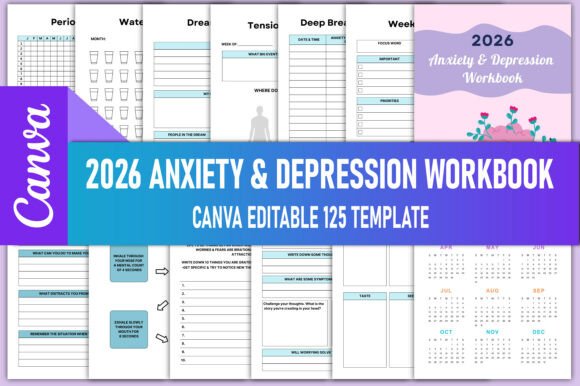
Designers and KDP publishers use the interior files as a production-ready foundation: clean typography, consistent spacing, accessible contrast, and intentional white space—all optimized for both digital use and high-resolution printing. No redesigning grids or adjusting margins. Just customize colors, swap fonts, insert brand elements, and export. The Dream Journal, Meditation Tracker, and Yoga Log aren’t decorative—they’re functional entry points for somatic awareness, making them especially valuable for integrative practitioners.
Real-World Use Cases Across Audiences
For therapists and counselors: Print individual sections as handouts—use the Stress Factor and Anxiety Tracker during intake, assign the Safety Plan and Therapy Notes pages between sessions, or integrate the Self Assessment and Change Mindset spreads into psychoeducation workshops. Because it’s editable, you retain full control over confidentiality—remove or modify sensitive headers before sharing.
For educators and workplace wellness leads: Adapt the Weekly Outline and Task Planning pages into classroom or team check-ins. Pair the Gratitude Log and I Am Grateful For… prompts with SEL (social-emotional learning) curricula. Use the Boundary Setting and Appointment Planning spreads to model healthy time management—not as productivity hacks, but as acts of self-respect.
For creators and solopreneurs: This workbook is a scalable product asset. Bundle the editable Canva file with a short video tutorial on customizing for anxiety recovery, burnout prevention, or postpartum mental wellness—and sell it as a premium digital download. Or publish multiple KDP versions: a minimalist black-and-white edition for clinical settings, a soft pastel version for teens, a bold typographic edition for creatives managing ADHD and anxiety.
Structure That Supports Consistency—Without Rigidity
Notice what’s included—and what’s intentionally *not* there. There’s no forced positivity. No “just think happy thoughts” messaging. Instead, you’ll find pragmatic tools like the Symptoms Tracker, Medication Tracker, and Doctor Visits log—designed for people navigating complex care pathways. The What Were You Like As A Child? prompt invites compassionate self-reflection, not nostalgia. The Master Checklist helps break overwhelm into micro-actions without implying that “getting it all done” equals healing.
The 2026 calendar isn’t filler—it anchors reflection in real time. Monthly reflection prompts tie progress to lived experience (“What shifted this month?” “Where did I protect my energy?”). The Water Tracker, Sleep Tracker, and Exercise Log reinforce the physiological foundations of mental health—without judgment or gamification. These aren’t habits to master; they’re data points to notice.
How to Customize With Purpose
When editing in Canva, start with function—not flair. Ask: Who is using this, and what do they need most right now?
- If targeting college students: emphasize the Daily Planner, Therapy Notes, and Stress Factor sections. Add campus-specific appointment reminders (e.g., “Counseling Center Walk-In Hours”).
- If supporting new parents: expand the Self Care Goals and Boundaries pages. Integrate gentle prompts like “One thing I’ll say no to today” or “Who can hold space for me this week?”
- If designing for neurodivergent users: increase font size in key trackers, add icon-based mood scales, and simplify instructions in the Thought Reframing section—using concrete examples (“Instead of ‘I failed,’ try ‘I tried something new’”).
Consistency comes from structure—not uniformity. Keep page dimensions, margin guides, and core section headers intact so printed versions remain KDP-compliant. But feel free to reorder spreads, combine related trackers (e.g., merge Stress Factor and Anxiety Tracker into one dual-axis chart), or add blank journaling pages after key prompts like Journaling Prompts for Anxiety or Inspirations.
Why This Works Beyond 2026
The year in the title isn’t arbitrary—it signals relevance. The 2026 Anxiety Depression Workbook includes a full 2026 calendar, yes—but its design philosophy is timeless. It meets people where they are: overwhelmed but capable, uncertain but curious, tired but still reaching for clarity. It doesn’t ask for transformation overnight. It offers scaffolding—page by page, week by week, breath by breath.
That’s why creators keep returning to it. It’s not just a product. It’s a framework—one that supports healing as an iterative, creative, deeply human process. Whether you’re publishing on KDP, guiding clients, teaching resilience, or rebuilding your own routine, this workbook gives you room to breathe, reflect, adjust, and move forward—with intention, not urgency.