Sleep Improvement Planner for Adults: A Practical Tool for Building Consistent, Restorative Sleep Habits
For many adults, improving sleep isn’t about finding a single “magic fix”—it’s about building awareness, consistency, and intentionality over time. The Sleep Improvement Planner for Adults is designed with that reality in mind: it’s not a prescriptive program or an app that pushes notifications, but a structured, reflective tool to support gradual, self-directed change. At its core, this planner helps users observe patterns, test small adjustments, and reinforce habits that align with their physiology and lifestyle—not someone else’s idealized routine.
What Sets This Planner Apart From Other Sleep Tools
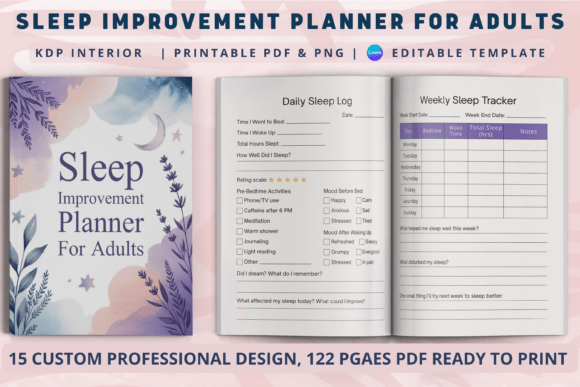
Most digital sleep trackers focus on output—hours slept, deep sleep minutes, heart rate variability—but offer little guidance on *why* patterns shift or *how* to respond meaningfully. In contrast, the Sleep Improvement Planner for Adults prioritizes input: what you did during the day, how you prepared at night, and how you felt before and after sleep. Its undated, printable PDF format means no forced start date or rigid scheduling—users begin when they’re ready, and progress at their own pace.
The inclusion of both daily and weekly tracking layers allows for short-term reflection (e.g., “Did skipping coffee after 2 p.m. help me fall asleep faster last night?”) and longer-term insight (e.g., “Over five days, I slept more soundly when I walked for 20 minutes before dinner”). Unlike generic habit trackers, this planner integrates sleep-specific metrics—like a validated Sleep Quality Rating Scale and a dedicated Evening Wind-Down Routine checklist—that reflect evidence-based behavioral principles without oversimplifying them.
How It Compares With Common Alternatives
Compared to journaling freely in a blank notebook, the Sleep Improvement Planner for Adults offers scaffolding: prompts, consistent categories, and visual layout cues that reduce decision fatigue. A user trying to track caffeine intake manually might forget to log afternoon tea—or misjudge portion sizes—but the built-in Caffeine Intake Log includes common sources (coffee, soda, chocolate, certain medications) and space for estimated milligrams or servings, supporting more accurate self-assessment.
When stacked against digital apps, the planner trades automation for agency. No syncing, no battery life concerns, no algorithm interpreting your data—but also no opaque scoring systems or nudges based on incomplete context. One person may prefer receiving gentle reminders from an app; another may find those interruptions counterproductive, especially if they’re already managing anxiety around sleep. The planner respects the user’s autonomy while still encouraging regular engagement through thoughtful design—not push notifications.
It also differs meaningfully from clinical sleep diaries used in cognitive behavioral therapy for insomnia (CBT-I). Those often require strict adherence to timing rules (e.g., “bedtime must be fixed within 30 minutes”) and exclude subjective ratings like mood or stress level. The Sleep Improvement Planner for Adults accommodates nuance: it invites notes on travel, illness, caregiving demands, or work deadlines—factors that real adults contend with but that rigid protocols sometimes overlook.
Strengths and Realistic Tradeoffs
A key strength lies in its flexibility across use cases. Because it’s available as both a printable PDF and a Canva-editable file, it supports multiple workflows: printing for tactile reflection, editing digitally for quick revisions, or adapting layout elements for personal preferences (e.g., enlarging font size for readability, adding custom columns). Its KDP-ready interior formatting also makes it viable for creators building wellness-themed print-on-demand journals—without needing graphic design expertise.
However, that flexibility comes with tradeoffs. Users who rely heavily on automated calculations—like averaging weekly sleep duration or graphing trends—won’t find built-in formulas or dynamic charts. Similarly, those seeking guided instruction (e.g., step-by-step wind-down scripts or breathing exercises) will need to supplement the planner with external resources. It’s a tool for observation and habit reinforcement—not a standalone curriculum.
The Screen Time Tracker, for instance, doesn’t block devices or estimate usage automatically—it asks users to record start/end times and note intent (“scrolled aimlessly,” “answered urgent emails,” “watched documentary”). That approach builds metacognition: users begin noticing *how* they use screens, not just *how long*. But it does require honest, consistent logging—and that effort is the planner’s quiet requirement.
Best-Fit Situations: When This Planner Adds Meaningful Value
This resource tends to resonate most with adults who:
- Prefer low-tech, low-distraction methods of self-reflection;
- Are early in their sleep improvement journey and benefit from structure rather than abstraction;
- Have tried apps or generic journals but struggled with consistency or relevance;
- Value having physical space to write, sketch, or annotate alongside sleep data;
- Want to identify personal patterns before committing to bigger changes (e.g., adjusting bedtime, reducing alcohol, starting light therapy).
Consider Sarah, 34, a project manager working hybrid hours. She tried three sleep apps over 18 months—each gave her different “sleep scores” and conflicting advice. Frustrated, she switched to the Sleep Improvement Planner for Adults. Within two weeks, her Daily Sleep Log revealed a pattern: nights following late-afternoon video calls consistently included longer sleep onset and more awakenings. That insight—not a score—led her to experiment with a 15-minute post-call walk instead of checking email, resulting in measurable improvement. The planner didn’t tell her what to do; it helped her see what was already true.
When Another Option Might Be More Appropriate
This planner is less suited for individuals experiencing persistent, severe insomnia (e.g., waking nightly for >30 minutes over three months), untreated sleep disorders like sleep apnea or restless legs syndrome, or those needing immediate clinical support. In those cases, consultation with a sleep specialist—and possibly diagnostic testing—should come first. The planner can complement care, but it isn’t a diagnostic or therapeutic substitute.
Similarly, users who thrive on gamified motivation, real-time feedback, or integration with wearable devices may find the manual nature limiting. If tracking heart rate variability or detecting snoring episodes matters more than understanding pre-sleep routines, a compatible wearable paired with a clinician-reviewed protocol would likely serve better.
And while the Canva-editable version allows customization, it doesn’t support collaborative editing, cloud backups, or cross-device sync. Someone managing shared household routines—like parents coordinating bedtime across children and adult schedules—may need a shared digital platform instead.
Making a Thoughtful Choice
Selecting a sleep support tool isn’t about choosing the “best” one overall—it’s about matching method to mindset, lifestyle, and current needs. The Sleep Improvement Planner for Adults excels when the goal is grounded, iterative learning: observing cause-and-effect, honoring individual rhythm, and building sustainable habits—not chasing overnight transformation. Its value emerges over days and weeks, not hours, and grows with the user’s willingness to engage honestly and patiently.
If you’re evaluating options, ask yourself: Do I benefit from structure that guides attention—not dictates behavior? Am I ready to invest time in reflection, not just recording? Does seeing my own patterns—in handwriting, on paper, or edited thoughtfully in Canva—help me feel more connected to my body’s signals? If yes, this planner offers a clear, adaptable, and human-centered path forward.