2026 End of Life Planner: A Practical, Customizable Resource for Intentional Planning
The 2026 End of Life Planner isn’t marketed as a novelty or trend—it’s built for clarity, continuity, and quiet confidence. Designed for adults who value preparedness without overwhelm, it serves a distinct purpose: helping individuals document personal, financial, legal, and emotional details in one structured, accessible place. Unlike generic journals or fragmented digital notes, this planner offers a thoughtfully sequenced framework—spanning from practical logistics (bank accounts, safe deposit boxes, device logins) to deeply personal reflections (letters of gratitude, apologies, final wishes). Its relevance extends beyond end-of-life considerations; it functions equally well as a comprehensive legacy organizer, estate readiness tool, or even a proactive family communication aid.
What You Actually Get—and Why It Matters
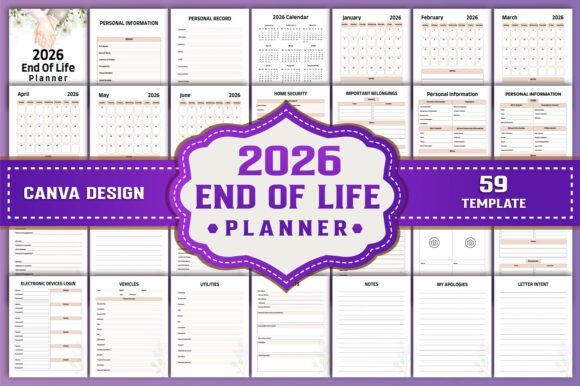
When you download the 2026 End of Life Planner, you receive print-ready PDF, JPG, and PNG files—all fully editable in Canva. The package includes 100 customizable original pages, each designed with intention—not filler. That means no duplicate spreads or decorative fluff. Every page has a functional role: “This Book Belongs To” establishes ownership and year; “Personal Information” and “Important Contacts” consolidate critical data; “End of Life Information” groups sensitive but essential items like funeral preferences and healthcare directives; “My Properties,” “Safe Deposit Boxes,” and “Electronic Devices Login Notes” reduce post-loss administrative friction.
Notably, the planner dedicates space to often-overlooked dimensions: “My Pets,” “Subscriptions & Utilities,” “Memberships,” and “Neighborhood Notes.” These aren’t afterthoughts—they reflect real-world complexity. A small business owner managing multiple SaaS tools, a freelancer with international bank accounts, or a caregiver coordinating care across households will recognize how quickly scattered information becomes a burden without a central reference. The inclusion of “Letter to Gratitude,” “Final Resting Wishes,” and “Special Instructions” also acknowledges that planning isn’t just transactional—it’s relational and human.
Usability Meets Flexibility
The Canva-based format is where the 2026 End of Life Planner distinguishes itself practically. Because all files are editable, users can adapt content to their exact needs: add fields for cryptocurrency wallets, adjust section order for cultural or religious preferences, translate headers for bilingual families, or simplify language for accessibility. No design skills are required—Canva’s interface supports straightforward text replacement, font changes, and image swaps. And since the output is print-ready, there’s no guesswork about bleed, margins, or resolution. You can generate a clean, professional-looking physical journal—or keep it digital for easy sharing with executors or attorneys.
That flexibility translates directly into time saved. Rather than assembling disparate templates from free online sources (many of which lack coherence or legal nuance), users start with a unified system. One educator reported using the “Insurance Information” and “Financial Information” spreads to pre-fill forms for her school’s benefits office—cutting down on back-and-forth emails. A freelance developer used the “Electronic Devices Login Notes” and “Internet Accounts” sections to audit and document his client-facing platforms before taking an extended sabbatical—giving his team immediate access if needed.
Who Benefits Most—and When
This planner serves professionals and individuals whose responsibilities extend beyond themselves: entrepreneurs managing business assets alongside personal ones; caregivers supporting aging parents while juggling their own obligations; creators building long-term audience trust and needing documented succession plans; educators and nonprofit staff preparing for leadership transitions; and even young adults establishing early financial and digital hygiene habits.
It’s especially valuable during life transitions: after a diagnosis, before major travel, when updating wills or trusts, during estate planning consultations, or simply as part of annual personal review routines. One small business owner used the “Vehicles,” “Home Security,” and “Utilities” pages to create a handover document for her property manager—streamlining operations when she relocated overseas. Another user—a blogger with a growing digital archive—adapted the “Electronic Devices” and “Profiles” sections to include cloud storage paths, domain registrar logins, and content licensing notes—ensuring her work remained accessible and ethically stewarded.
Quality, Consistency, and Real-World Reliability
The 2026 End of Life Planner avoids visual clutter without sacrificing warmth. Typography is legible at standard print sizes; spacing allows room for handwritten notes or typed additions; color use (where present) is subtle and inclusive—no high-contrast combinations that strain readability. Each section flows logically into the next, minimizing cognitive load. There’s no forced positivity or euphemism—just clear, neutral prompts that respect the user’s autonomy and emotional range.
Reliability comes from structure, not rigidity. Unlike rigid legal forms that require notarization or jurisdiction-specific wording, this planner acts as a living companion—not a replacement for formal documents. It’s meant to be updated, annotated, and reviewed periodically. Users consistently report returning to it months after initial setup—not because they forgot, but because new accounts opened, pets were adopted, or relationships evolved. That iterative usability signals thoughtful design, not static utility.
Practical Considerations and Limitations
It’s important to clarify what the 2026 End of Life Planner is not: it’s not a legally binding instrument, nor does it substitute for attorney-reviewed wills, powers of attorney, or advance healthcare directives. Its strength lies in preparation—not authorization. Users should still consult qualified professionals for formal documentation, especially across state or national borders.
Also, while Canva editing is intuitive, users unfamiliar with the platform may need 15–20 minutes to orient themselves—particularly when adjusting multi-page layouts or exporting print-ready PDFs with correct settings. The planner assumes basic digital literacy but doesn’t require advanced technical skill. For those preferring offline-only workflows, printing and handwriting remain fully viable options—the layout accommodates both.
Making It Work for Your Workflow
Start small. Don’t aim to complete all 100 pages in one sitting. Pick three high-impact sections first: “Personal Information,” “Important Contacts,” and “End of Life Information.” Fill those with verified details. Then, over the next few weeks, add “Bank Accounts,” “Electronic Devices,” and “My Pets.” Revisit quarterly—or after any major change—to update passwords, contacts, or wishes.
If you’re sharing with family or executors, export a clean PDF version (with personal details redacted if needed) and store it in a secure but accessible location—like an encrypted cloud folder with shared access, or a physical copy in a home safe. Pair it with a brief cover note explaining where it lives and why it exists. That simple step transforms the planner from a private tool into a functional bridge between intention and action.
For creators, marketers, or educators, the editable nature opens additional uses: adapting pages for client workshops on legacy planning, embedding sections into course materials, or customizing layouts for niche audiences (e.g., adding crypto wallet fields for tech clients or multilingual headers for immigrant communities). The investment isn’t just in the file—it’s in the time reclaimed, the uncertainty reduced, and the dignity preserved through deliberate, compassionate preparation.