A Life in the Woods Story Books: Where Narrative Design Meets Intentional Living
In an era defined by digital saturation, fragmented attention, and rising demand for meaningful engagement—both in content creation and personal development—A Life in the Woods Story Books emerges not as a novelty, but as a timely convergence of storytelling craft, intentional design, and human-centered workflow innovation. More than a children’s storybook or a printable journal, it represents a new category: the story-planner—a hybrid format engineered for creators, educators, therapists, indie publishers, and mindful professionals who seek depth without complexity, structure without rigidity, and inspiration that invites participation—not passive consumption.
Beyond the Page: A Designed Experience for Modern Creators
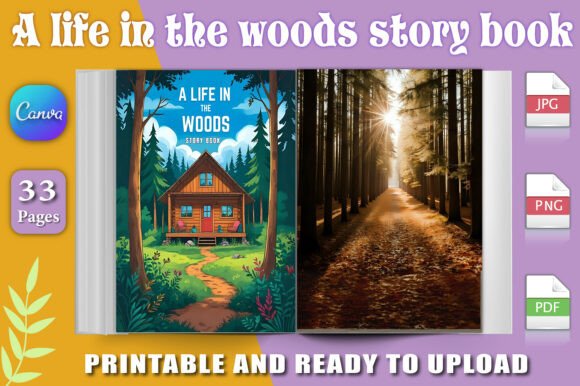
A Life in the Woods Story Books centers on Elara, a protagonist whose quiet departure from urban life to a forest cabin mirrors a growing cultural pivot: away from extraction-based productivity and toward regenerative presence. But what distinguishes this title is its architecture. Each of its five thematic chapters—aligned with seasonal progression from Spring beginnings to Winter renewal—integrates three essential layers: a concise, emotionally grounded narrative; open-ended illustration prompts calibrated for AI image generation (e.g., “cozy log cabin at dawn, mist rising between pine trees, soft watercolor texture, gentle light”); and intentionally blank space for reflection, sketching, or note-taking. This tripartite structure transforms reading into doing—turning passive reception into active co-creation.
For creators building KDP interiors, this isn’t just “printable content.” It’s a production-ready system. The 33-page PDFs are optimized for 8.5 x 11” print, with consistent margins, balanced typography, and generous white space—all critical for readability and visual coherence. The editable Canva template further lowers the barrier to customization: marketers can rebrand chapter headers for client workshops; educators can adapt prompts for SEL (social-emotional learning) curricula; freelance illustrators can use the AI art prompts as springboards for original commissions. In short, A Life in the Woods Story Books functions as both a finished product and a flexible creative scaffold.
Aligning With Macro Trends in Content, Commerce, and Consciousness
This release lands precisely where several powerful currents intersect:
- The Rise of “Slow Media”: As algorithm-driven feeds accelerate cognitive fatigue, audiences increasingly favor content with rhythm, restraint, and resonance. Elara’s unhurried journey—marked by seasonal pacing and sensory detail—offers a counterpoint to viral velocity. Publishers report stronger retention and repeat engagement with titles that encourage return visits, not one-time scrolls.
- The Democratization of Visual Creation: With AI image tools now accessible to non-designers, the demand has shifted from static assets to prompt-literate design. A Life in the Woods Story Books anticipates this by embedding ready-to-use, context-aware prompts—each tied to narrative mood and thematic intent—not generic stock descriptors. This bridges technical capability with artistic intention.
- The Professionalization of Self-Development: Mindfulness is no longer confined to wellness apps or retreat centers. Freelancers schedule “forest hours” alongside client calls; remote teams embed nature metaphors into sprint retrospectives; entrepreneurs cite ecological resilience as a model for business adaptation. Elara’s arc—from disorientation to rooted confidence—mirrors real-world skill-building: observation, iteration, boundary-setting, and responsive action.
Why Professionals Are Adopting This Format—Not Just Buying It
It’s telling that early adopters include not only authors and teachers—but also UX researchers using the journal-friendly layout for empathy mapping, sustainability consultants adapting seasonal frameworks for stakeholder workshops, and brand strategists repurposing the cabin-in-the-woods aesthetic to communicate authenticity in crowded markets. Their use cases reveal a deeper shift: professionals no longer treat tools as isolated utilities. They seek interoperable systems—assets that serve multiple roles across workflows.
Consider a freelance marketer developing a brand voice guide for an eco-apparel startup. Instead of drafting abstract tone-of-voice statements, they might assign team members to complete Chapter 3 (“Summer Abundance”) from A Life in the Woods Story Books, then discuss how Elara’s joyful harvesting parallels the brand’s commitment to ethical sourcing. The shared narrative becomes a common language—more vivid and memorable than bullet-pointed guidelines.
Similarly, a KDP entrepreneur launching a series of themed journals doesn’t need to build each interior from scratch. The consistent structure of A Life in the Woods Story Books provides a proven template: narrative hook → visual prompt → reflective space. Scaling becomes about variation—not reinvention. Seasonal themes allow for natural product line extensions (e.g., “A Life by the Sea,” “A Life on the Prairie”), while retaining the same intuitive user experience.
Designing for Human Needs—Not Just Market Gaps
What makes A Life in the Woods Story Books resonate beyond aesthetics or utility is its fidelity to underlying human needs: the need for continuity (seasonal progression mirrors natural cycles of growth and rest), the need for agency (illustration prompts invite personal interpretation, not prescriptive answers), and the need for embodied cognition (handwriting notes or sketching beside text strengthens memory and meaning-making).
This aligns with research in cognitive psychology showing that multimodal engagement—combining reading, visualizing, and writing—increases neural encoding far more than single-mode input. For professionals managing complex information loads, this isn’t nostalgia for analog—it’s evidence-informed workflow design. The cabin-in-the-woods aesthetic isn’t escapism; it’s a deliberate cognitive frame—a visual shorthand for safety, simplicity, and grounded attention.
Practical Integration: From Concept to Consistent Practice
Adoption succeeds when integration feels frictionless. Here’s how forward-thinking users are embedding A Life in the Woods Story Books into daily practice:
- Weekly Creative Anchoring: A graphic designer blocks 25 minutes every Monday morning to read one chapter section and respond to the illustration prompt using MidJourney or DALL·E—then saves outputs to a private Notion gallery. Over time, this builds a personalized visual vocabulary aligned with core values.
- Client Onboarding Ritual: A life coach emails a PDF excerpt from Chapter 2 (“Spring Roots”) before the first session. Clients arrive having reflected on their own “first steps”—creating immediate emotional resonance and reducing intake-form fatigue.
- Team Reflection Cadence: A remote SaaS team dedicates the last 15 minutes of their quarterly planning meeting to silently engaging with the Winter chapter. They then share one sentence about “what I’m releasing” and “what I’m preparing to renew”—grounding strategic discussion in shared metaphor.
Looking Ahead: A Template for Intentional Systems
A Life in the Woods Story Books signals something broader than a successful KDP launch. It reflects a maturing understanding among creators: that value lies not in producing more content, but in designing containers for meaning. Its seasonal scaffolding, prompt-integrated visuals, and journal-ready layout don’t just support individual expression—they model how to build systems that honor attention spans, honor creative diversity, and honor the slow, cyclical nature of real growth.
As AI reshapes how we generate, edit, and distribute content, the differentiator won’t be speed or scale—it will be intentionality. Tools that clarify purpose, deepen connection, and invite thoughtful response will define the next wave of professional-grade resources. A Life in the Woods Story Books doesn’t chase trends. It cultivates them—quietly, deliberately, one season at a time.