2025 Self-Control Activity Book: A Print-Ready, Fully Customizable KDP Interior for Emotional Growth & Daily Resilience
Self-control isn’t just about resisting cookies or putting your phone down—it’s the quiet engine behind emotional intelligence, academic success, healthy relationships, and long-term well-being. In a world of constant digital stimulation, shifting expectations, and rising stress levels, cultivating self-regulation skills has never been more essential. That’s where the 2025 Self-Control Activity Book steps in—not as a rigid workbook, but as a compassionate, research-informed, and deeply practical tool designed for real life.
What Is the 2025 Self-Control Activity Book—and Why Does It Matter?
This isn’t another generic journal or bullet planner. The 2025 Self-Control Activity Book is a purpose-built, print-ready interior file created specifically for Amazon KDP (Kindle Direct Publishing) creators—but equally valuable for educators, therapists, counselors, parents, and anyone committed to mindful personal development. At its core, it’s a structured yet flexible framework that guides users through evidence-based self-regulation strategies using accessible, age-inclusive language and visual scaffolding.
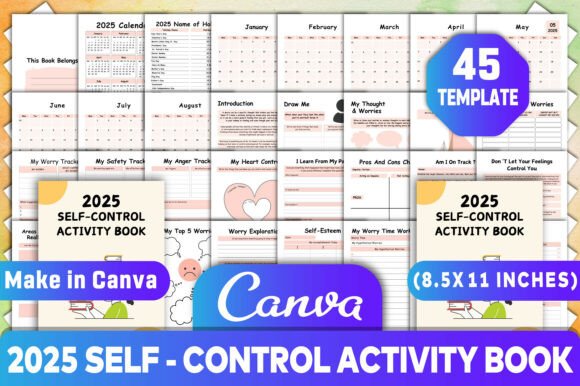
Unlike static PDFs or pre-filled templates, this resource arrives as a 100% customizable original file, delivered in multiple formats: printable PDF, high-resolution JPG and PNG, and—most importantly—an editable Canva template. That means you’re not just downloading a book—you’re receiving full creative control over fonts, colors, layout, illustrations, and even content wording. Whether you're branding it for your wellness coaching business, adapting it for middle-school SEL (Social-Emotional Learning) curriculum, or personalizing it for your child’s anxiety support plan, the flexibility is built in.
Inside the Book: A Thoughtfully Sequenced Journey Through Self-Regulation
The structure reflects developmental psychology best practices—starting with awareness, moving into reflection, and culminating in empowered action. Each section builds on the last, gently guiding users from identifying emotions to making intentional choices. Here’s how it unfolds:
- “This Book Belongs To” + 2025 Calendar — Personalization grounds ownership and intentionality.
- Monthly Planners (Jan–Dec) + 2025 Holiday Names — Connects time management with cultural and emotional context (e.g., noting “Gratitude Day” or “Mindful Breathing Week”).
- “My Thought Worries” & “My Worry Boat” — Uses metaphor and drawing (“Draw Me”) to externalize abstract anxieties, reducing their intensity.
- “My Types Of Worries” & “My Worry Tracker” — Helps distinguish between solvable vs. unsolvable concerns—a foundational CBT (Cognitive Behavioral Therapy) skill.
- “My Safety Tracker” & “My Anger Tracker” — Encourages body-awareness and early intervention before escalation.
- “My Heart Control” & “Control Yourself” — Introduces paced breathing, grounding techniques, and impulse-delay strategies.
- “I Learn From My Past” & “Pros And Cons Chart” — Builds reflective thinking and decision-making literacy.
- “Am I On Track?” & “Don’t Let Your Feelings Control You” — Reinforces agency and self-efficacy without toxic positivity.
- “Areas Of My Life That Are Really Important To Me” & “My Think Sheet” — Aligns daily choices with core values—key for adult professionals and teens alike.
- “Things I Control / Things I Can’t Control” — A modern adaptation of the Stoic dichotomy of control, made tangible and actionable.
- “Final Thought,” “Notes,” and “Thank You” — Ends with closure, gratitude, and space for ongoing growth.
Why These Sections Work—Beyond the Checklist
It’s easy to skim a list of worksheet titles and assume they’re just “fill-in-the-blank” exercises. But what makes this activity book effective is its intentional scaffolding. For example, “My Worry Time Worksheet” doesn’t ask users to suppress worry—it teaches them to contain it: scheduling 10 minutes daily to explore fears with curiosity, then consciously stepping away. Similarly, “My Safety Tracker” pairs emotion labels (“I feel shaky”) with sensory anchors (“I held my smooth stone”), bridging neuroscience with lived experience.
And because it includes the 2025 calendar and holiday names, it supports temporal grounding—especially helpful for neurodivergent individuals or those recovering from burnout who benefit from predictable, culturally resonant markers of time.
Who Benefits Most—and How?
Educators & School Counselors: Use it as a supplemental SEL curriculum tool aligned with CASEL standards. Print individual pages for classroom warm-ups or bind copies for student-led reflection journals.
Mental Health Professionals: Adapt worksheets for clients managing anxiety, ADHD, or emotional dysregulation—customizing language for age, culture, or clinical goals.
KDP Publishers & Creatives: Launch a low-risk, high-value niche product. With Canva integration, you can rapidly produce themed versions (e.g., “Self-Control for Teens,” “Anxiety Relief Edition,” “Faith-Based Reflection Journal”)—all from one master file.
Parents & Caregivers: Support children’s emotional vocabulary and coping skills without needing therapy training. The visual prompts and gentle tone reduce resistance and invite collaboration.
Adult Learners & Professionals: Rebuild executive function after pandemic-related disruption—or strengthen resilience amid workplace uncertainty. “Getting Ahead,” “My Notes,” and “Areas of My Life That Are Important” directly support goal clarity and boundary-setting.
Clarifying Common Misconceptions
Misconception #1: “Self-control means suppressing emotions.”
Reality: This book emphasizes understanding, naming, and channeling emotions—not erasing them. “My Anger Tracker” invites users to notice physical cues *before* reacting—making space for choice.
Misconception #2: “It’s only for kids or people with diagnosed challenges.”
Reality: Self-regulation is a universal skill, like literacy or numeracy. Adults navigating remote work fatigue, caregiving stress, or decision overload benefit just as much—and often more—from structured reflection tools.
Misconception #3: “Editable = low quality.”
Reality: The Canva template is professionally designed at 8.5 x 11 inches, print-optimized (300 DPI), with consistent typography, intuitive spacing, and accessibility-conscious contrast. You’re editing a polished foundation—not starting from scratch.
Practical Next Steps: How to Use Your Download
- Download your files: Receive PDF (for immediate printing), JPG/PNG (for social media or presentations), and a unique Canva link.
- Customize freely: Change colors to match your brand, add your logo, adjust instructions, or translate sections—no design software required.
- Print or publish: Use the PDF for home or classroom use—or upload the interior to KDP with your custom cover for a polished paperback.
- Integrate intentionally: Start with one section per week. Pair “My Worry Tracker” with a 2-minute breathing exercise. Use “Things I Control” during Sunday planning sessions.
Remember: self-control isn’t about perfection. It’s about showing up, again and again, with kindness and curiosity—even when your worry boat rocks. The 2025 Self-Control Activity Book doesn’t promise instant transformation. It offers something more powerful: a reliable, adaptable, and deeply human companion for the lifelong practice of choosing who you want to be—in your thoughts, your actions, and your relationships.
Whether you're publishing on KDP, supporting a student, healing alongside your family, or simply reclaiming calm in a chaotic year—this resource meets you where you are. Because in 2025 and beyond, the most revolutionary act isn’t doing more. It’s pausing, reflecting, and responding—with intention.