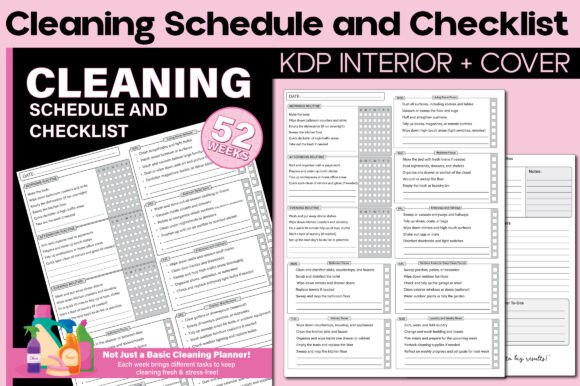
Cleaning Schedule and Checklist - KDP
The Cleaning Schedule and Checklist - KDP is a ready-to-use, 109-page printable PDF resource designed for creators preparing to publish a physical or digital cleaning planner on Amazon Kindle Direct Publishing (KDP). It includes two interior design options and one professionally formatted cover, all optimized for KDP’s print-on-demand requirements. The file is structured as a functional log book—organized with dated pages, task categories, habit trackers, and space for notes—intended to support consistent household or light commercial cleaning routines.
This product is not software, an app, or a subscription service. It is a static, pre-designed template intended for immediate upload and publication. Its purpose is to reduce the time and technical effort required to develop a market-ready cleaning journal, particularly for authors, small business owners, or designers who want to offer a practical, low-maintenance productivity tool without building layouts from scratch.
People often consider the Cleaning Schedule and Checklist - KDP when they’re evaluating whether to launch a niche planner on Amazon. Common motivations include generating passive income through KDP’s royalty model, supporting a related service (e.g., home organization coaching), or expanding an existing product line of journals or workbooks. Because it requires no coding, graphic design expertise, or ongoing maintenance, it appeals to those prioritizing speed-to-market and simplicity over customization.
One key benefit is efficiency: the file arrives fully formatted for KDP’s trim sizes, bleed settings, and margin guidelines. Both interior designs follow standard planner conventions—such as weekly or monthly grids, check boxes, and clean typography—making them legible and functional for daily use. The inclusion of two interior options allows for A/B testing different layouts or targeting distinct reader preferences (e.g., minimalist vs. feature-rich). The cover is print-ready and adheres to KDP’s image resolution and safe-zone requirements, reducing the risk of rejection during upload.
However, there are tradeoffs. Because the content is fixed, users cannot modify core elements like page order, section headings, or tracking logic without editing the PDF directly—a process requiring familiarity with tools like Adobe Acrobat Pro or InDesign. There is no built-in digital functionality (e.g., hyperlinked tabs, fillable fields, or auto-calculating totals), so it functions strictly as a printed workbook. Readers expecting dynamic features—such as recurring task reminders, progress analytics, or integration with calendar apps—will find this format limiting.
Another consideration is audience alignment. The Cleaning Schedule and Checklist - KDP works best for readers seeking a tactile, analog system. It suits individuals managing routine household upkeep, caregivers overseeing shared living spaces, or small-property landlords maintaining rental units. Its structure supports consistency more than deep customization—ideal for users who prefer checking off tasks in pen rather than toggling digital toggles. If your target reader values simplicity, portability, and low cognitive load, this format meets that need reliably.
Conversely, alternatives may be preferable in several situations. For example, someone building a branded ecosystem—say, a home organization coach offering courses, consultations, and digital tools—may benefit more from a custom-designed Notion template or Airtable base. These platforms allow real-time updates, conditional logic, and client-specific adaptations, which a static PDF cannot replicate. Similarly, readers who rely heavily on mobile access or voice input may find paper-based logs inconvenient, especially if they manage multiple locations or irregular schedules.
There’s also the question of differentiation. While the Cleaning Schedule and Checklist - KDP provides solid foundational structure, it does not inherently stand out in a crowded KDP category. Success depends less on the template itself and more on how it’s positioned—through targeted keywords, compelling cover design, clear description copy, and thoughtful backend metadata. Without strategic marketing or a defined niche (e.g., “Cleaning Schedule for Neurodivergent Adults” or “Postpartum Home Maintenance Log”), even a well-formatted book may struggle to gain visibility among thousands of similar titles.
Practical decision-making starts with clarifying intent. Ask yourself: Is my goal to test demand for cleaning planners with minimal investment? Am I comfortable handling customer service, returns, and KDP policy compliance independently? Do I already have a platform—email list, social media presence, or complementary product—to drive initial sales? If the answers point toward experimentation, lean operations, and learning-by-doing, then the Cleaning Schedule and Checklist - KDP offers a reasonable starting point.
On the other hand, if you aim to build long-term authority in home management or productivity, investing time in original content development—such as adding educational sidebars, seasonal deep-cleaning guides, or maintenance timelines—may yield stronger reader loyalty and higher perceived value. Likewise, if your ideal customer frequently uses digital tools, exploring hybrid models (e.g., pairing a printed log book with a free companion checklist PDF) could broaden appeal without sacrificing the tactile experience.
It’s also worth noting compatibility constraints. The file is delivered as a PDF—not editable source files (e.g., .indd or .psd). That means color adjustments, font swaps, or structural changes require either advanced PDF editing skills or outsourcing to a designer. Users unfamiliar with KDP’s previewer should plan time to verify page alignment, header/footer placement, and grayscale rendering before final submission. Small formatting oversights can lead to misaligned margins or cut-off text in the printed version.
Finally, expectations around usage matter. This is not a turnkey business—it’s a component. Revenue depends on pricing strategy, keyword optimization, competitive analysis, and post-launch promotion. While the Cleaning Schedule and Checklist - KDP eliminates layout work, it doesn’t replace the need for understanding KDP’s royalty structure, tax documentation, or Amazon’s content policies. Authors should review KDP’s latest guidelines on interior content, cover specifications, and prohibited language before uploading.
In summary, the Cleaning Schedule and Checklist - KDP serves a specific role: accelerating the creation of a functional, print-ready cleaning journal for KDP. It fits well for creators focused on execution over innovation, willing to accept tradeoffs in flexibility for gains in speed and simplicity. Whether it aligns with your goals depends not on the template alone, but on how thoughtfully it integrates into your broader publishing strategy, audience needs, and operational capacity.